Beyond the Audit: What High-Performing Supplier Quality Teams Do Differently
Why audits alone are not enough for supplier quality, and what strong teams do instead to stay ahead of supplier risk.

Audits matter.
But they are not a supplier quality strategy on their own.
Too many teams still treat audits as the backbone of supplier quality. It is easy to see why. Audits are structured. They are familiar. They create documentation. They make progress visible.
But audits are periodic. Supplier quality problems are not.
Defects happen between audits. Communication breaks down between audits. Corrective actions stall between audits. Supplier performance drifts between audits.
If your main question is “When is the next audit?”, you are probably managing supplier quality too late.
The best teams ask a different question:
What is happening with this supplier right now?
Audits create visibility, but only for a moment
An audit is a snapshot.
It tells you something useful about a supplier at a point in time. It can uncover process weaknesses, confirm compliance, and give teams a reason to take a closer look.
That is valuable.
But a snapshot is not the same as control.
A supplier can look solid during an audit and still create daily friction afterward. Minor quality issues can build up quietly. Response times can slow down. Corrective actions can drag on. Documentation can go stale. None of that waits for the next scheduled visit.
This is where audit-heavy supplier quality programs start to break down.
The team feels busy. The process looks formal. But the real operating model is reactive.
Why audit-heavy teams keep getting surprised
The problem is not that audits are bad.
The problem is that audits are often used to compensate for weak day-to-day supplier management.
When that happens, three things usually follow.
1. Issue handling becomes reactive
If quality issues are tracked loosely across inboxes, spreadsheets, and disconnected systems, teams usually respond only after problems become impossible to ignore.
The supplier may have been signaling trouble for weeks. But no one had a clear, current view.
So the team reacts late.
2. Supplier engagement happens in bursts
Some teams are highly engaged during onboarding, audits, and escalations, then mostly silent in between.
That creates long gaps where expectations are unclear and momentum disappears.
Strong supplier relationships are not built on occasional formal reviews. They are built on consistent operational communication.
3. Risk is identified too slowly
Most supplier risk does not arrive as one dramatic event.
It shows up as a pattern.
A delayed response here. A recurring defect there. A corrective action that stays open too long. A supplier score that trends in the wrong direction for three straight months.
When those signals are scattered, teams miss the pattern until the problem is already expensive.
What high-performing supplier quality teams do differently
The strongest teams do not abandon audits.
They put audits in the right place.
Instead of relying on periodic inspection to tell them how a supplier is doing, they build a more continuous way of working around supplier quality.
That usually includes four things.
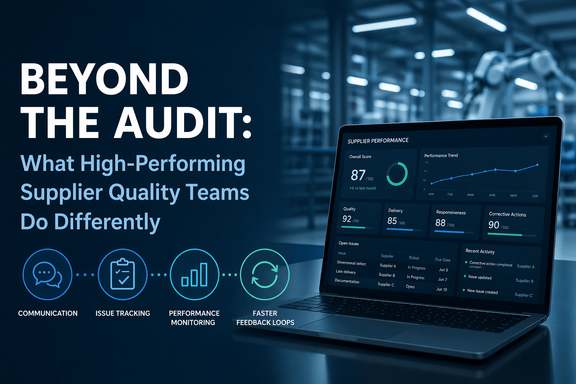
1. They stay in regular contact with suppliers
High-performing teams do not save meaningful interaction for audits and emergencies.
They create a steady rhythm of communication.
That does not mean more meetings for the sake of meetings. It means suppliers know what matters, what is open, what needs attention, and how performance is trending.
This matters more than many teams realize.
When communication is inconsistent, suppliers often respond only to the loudest problem. When communication is structured and ongoing, suppliers are more likely to act earlier and align faster.
2. They track issues in real time
This is one of the clearest differences between reactive teams and proactive ones.
Reactive teams often discover the state of supplier issues by asking around.
High-performing teams can see it immediately.
They know:
- what issues are open
- who owns them
- how long they have been open
- which suppliers are repeatedly involved
- where corrective actions are stuck
That visibility changes behavior.
It becomes easier to escalate early, follow up with precision, and spot repeat patterns before they become major failures.
3. They monitor supplier performance continuously
A supplier scorecard should not be a quarterly document that gets reviewed once and forgotten.
Strong teams treat supplier performance as a live management input.
They track a few metrics that actually matter. Usually that includes some mix of:
- quality performance
- delivery performance
- responsiveness
- corrective action closure
- audit outcomes
The point is not to create more reporting.
The point is to create earlier signal detection.
When teams can see movement in supplier performance over time, they are in a much better position to intervene early instead of escalating late.
4. They shorten feedback loops
Many supplier quality problems get worse simply because feedback arrives too slowly.
By the time the supplier gets clear information, the same issue has already repeated. Internal frustration rises. Trust drops. More energy goes into chasing updates than solving the root cause.
High-performing teams tighten that loop.
They make it easier to log issues quickly, communicate clearly, assign next steps, and keep momentum visible on both sides.
That speed matters.
Not because every issue is urgent, but because delayed feedback is one of the easiest ways to turn a manageable problem into a recurring one.
The real shift is operational, not procedural
This is the deeper change.
Weak supplier quality programs are built around events.
Audits. Reviews. Escalations. Quarterly meetings.
Strong supplier quality programs are built around operational visibility.
They are less dependent on formal checkpoints because they already have a better view of what is happening between them.
That changes the team’s posture.
Instead of asking: “When is the next audit?”
They ask: “What is happening with this supplier right now?”
That is a much stronger question.
It pushes the team toward current facts instead of calendar-driven control. It makes supplier quality more continuous, more responsive, and more useful to the business.
Audits still matter, just not as the whole system
None of this means audits are obsolete.
Audits still play an important role. They help validate processes, assess compliance, and create structured opportunities for deeper review.
But they work best when they are part of a broader supplier quality system.
The best teams do not depend on audits to discover everything.
They use audits to confirm, challenge, and deepen what they already know from continuous supplier visibility.
That is a very different operating model.
Why this is hard for many teams
Most teams do not stay audit-heavy because they believe it is ideal.
They stay there because continuous supplier quality is harder to run when everything is fragmented.
Communication happens in email. Corrective actions live in spreadsheets. Audit findings sit in one place. Supplier performance data lives somewhere else. Everyone is working, but no one has a complete picture.
That fragmentation creates delay.
And delay creates reactive supplier quality.
This is exactly where a platform like Supplios fits. When supplier communication, issue tracking, corrective actions, and supplier performance visibility are managed in one place, teams can spend less time reconstructing the current state and more time acting on it.
That is the real difference between documenting supplier quality and actually managing it.
Final thought
Audits are important.
But they are not enough.
If audits are doing most of the work in your supplier quality process, your team is probably relying too heavily on periodic review and not enough on day-to-day visibility.
The strongest supplier quality teams do something simpler and harder:
They stay close to what is happening now.
That is where proactive supplier quality starts.
Take a hard look at your current process: how much of your supplier quality effort helps you prevent issues early, and how much of it only helps you document them after the fact?