How to Drive Supplier Responsiveness Without Constant Follow-Up
How to reduce supplier response delays by replacing manual follow-up with clearer expectations, structured workflows, and visible accountability.

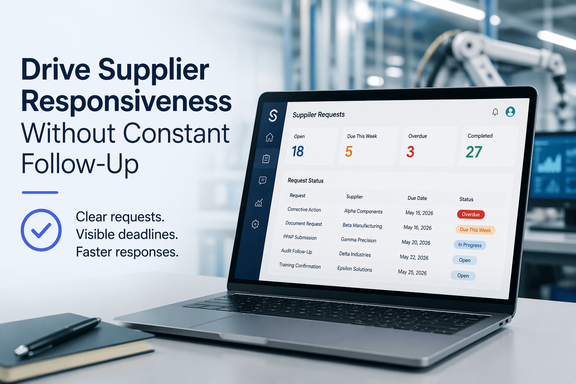
If your team spends time chasing suppliers, the process is broken.
That is the uncomfortable truth behind a lot of “supplier responsiveness” problems.
Most teams treat slow supplier replies as a people problem. They assume the supplier is disorganized, uncommitted, or just difficult to manage. Sometimes that is true. But more often, the bigger issue is simpler: the request itself is unclear, the deadline is vague, the communication is fragmented, and nobody can see what is still open.
In that environment, follow-up becomes part of the workflow.
And that is the real problem.
A healthy supplier process should not depend on someone sending reminder emails, making calls, and asking internally, “Did anyone hear back yet?” If it does, the process is doing too much work manually.
Slow supplier response is usually a systems issue
When suppliers respond late, teams often react by pushing harder.
More reminder emails. More escalation. More internal checking. More “just following up” messages.
That can work in the short term. But it does not actually improve responsiveness. It just trains the process to rely on manual pressure.
The result is predictable:
- Internal teams waste time following up instead of solving problems
- Suppliers get inconsistent requests from different people
- Deadlines slip because nobody owns the timeline clearly
- Status becomes difficult to trust
A process that depends on constant chasing is not efficient. It is fragile.
Why supplier delays happen in the first place
Supplier response delays usually come from a small set of repeatable process failures.
1. Expectations are unclear
A lot of supplier requests are vague.
A team sends an email asking for an update, a document, or a corrective action response. But the request does not clearly define what is needed, who should respond, or what “done” looks like.
From the supplier side, that creates hesitation. They may not know whether a partial answer is acceptable, whether more detail is needed, or whether the issue is actually urgent.
Unclear requests create slow replies.
2. There is no real deadline
Many supplier requests include urgency, but not an actual due date.
“Please send this as soon as possible” is not a deadline. Neither is “urgent.”
If the supplier is juggling multiple customers, internal approvals, and production issues, vague urgency loses every time to a specific date.
Clear deadlines improve responsiveness because they remove guesswork.
3. Visibility is poor
In many companies, supplier communication lives across inboxes, spreadsheets, calls, and scattered notes.
That creates two problems.
First, internal teams do not know what is open, overdue, or blocked without asking around.
Second, suppliers do not experience a consistent process. They may get multiple follow-ups from different people, or they may assume someone else has already responded.
Poor visibility makes everything slower.
4. Communication is fragmented
When requests, documents, clarifications, and updates are spread across separate email threads, response quality drops.
Important context gets buried. Attachments get lost. Different versions circulate. Internal stakeholders interpret status differently.
At that point, slow response is almost guaranteed. Not because the supplier is ignoring the issue, but because the workflow itself is messy.
More follow-up is not a fix
This is where many teams get stuck.
They know suppliers respond slowly, so they build follow-up into the routine. Someone on the team becomes responsible for nudging, reminding, and checking in. It feels practical. It feels proactive.
But it is a patch, not a solution.
The hidden cost of manual follow-up is bigger than it looks:
- time spent chasing instead of improving supplier performance
- inconsistent pressure depending on who follows up
- less trust in reported status
- more internal coordination just to understand what is happening
Over time, teams start measuring effort instead of effectiveness. They feel busy, but the system is not getting better.
The real goal is not to become better at following up.
The goal is to need less follow-up in the first place.
What actually improves supplier response times
If you want faster supplier responses, you need to make the process easier to respond to and harder to ignore.
That usually comes down to four things.
Set clear SLAs
Different supplier interactions should have different response expectations.
A corrective action request should not be treated the same way as a missing certificate or a routine documentation update.
Set service expectations by request type. For example:
- acknowledgment within 24 hours
- containment response within 48 hours
- full corrective action response within 10 business days
- document submission by a defined due date
This does two things. It gives suppliers a clear target, and it gives your team a fair way to manage performance.
Without an SLA, every delay becomes subjective.
Make requests structured
Suppliers respond faster when the ask is clear.
That means each request should have:
- a clear owner
- a due date
- a defined request type
- the required inputs or attachments
- a visible status
This sounds basic, but many supplier delays come from missing exactly these things.
A vague email creates back-and-forth. A structured request creates movement.
Track everything centrally
If a request is important, it should not live only in one person’s inbox.
Central tracking changes the dynamic immediately. Instead of asking, “Has anyone followed up?” the team can ask, “What is overdue?” That is a much better management question.
When status is visible, suppliers are easier to manage and internal teams stay aligned.
This also makes escalation more intelligent. You can see patterns instead of reacting to anecdotes.
Build supplier accountability into the workflow
Supplier responsiveness improves when deadlines, ownership, and history are visible.
Not because suppliers like being monitored, but because clarity creates accountability.
When a supplier can see what is due, when it is due, and what is still open, the process becomes more predictable. When your team can see which suppliers consistently miss response windows, performance conversations become much more concrete.
That is when responsiveness stops being a vague complaint and becomes a measurable operating metric.
What this looks like in practice
Take a common example: a corrective action request.
In a weak process, the supplier gets an email with a problem description and an attachment. The subject line may say “urgent,” but there is no clear due date, no defined response format, and no shared status view internally. A week later, someone follows up. Then someone else follows up again. Nobody is fully sure what has been received.
In a stronger process, the request is logged with a deadline, assigned to a supplier contact, and tracked visibly. The supplier knows exactly what is required. Internal teams can see whether the request is open, overdue, under review, or completed.
That does not magically make every supplier faster.
But it does remove the friction that causes a surprising amount of delay.
The same pattern applies to document collection, audit follow-ups, onboarding actions, and supplier performance reviews. Faster responses usually come from clearer process design, not louder reminders.
The shift from chasing to managing
This is the mindset change that matters.
Weak supplier workflows create a culture of chasing. Strong ones create a culture of management.
Chasing sounds like this:
“Can you follow up again?” “Did they send anything?” “Who owns this now?” “Can you resend the attachment?”
Managing sounds like this:
“What is overdue?” “Which suppliers are missing response targets?” “Where are the bottlenecks?” “What needs escalation?”
That is a much better way to run supplier operations.
It is also the point where performance management starts to improve. Once responsiveness is visible and measurable, you can use it in scorecards, reviews, and supplier development plans instead of relying on frustration and memory.
Where Supplios fits
This is exactly where a structured supplier quality system matters.
Supplios helps teams move supplier requests out of scattered email threads and into a shared workflow where expectations, deadlines, communication, and status are visible in one place.
That means fewer manual reminders, less confusion internally, and better accountability with suppliers.
The point is not to send prettier follow-ups.
The point is to build a process that no longer depends on them.
Less chasing is the result of better process design
If your team spends too much time following up with suppliers, do not treat that as normal overhead.
Treat it as a signal.
It usually means the request is not structured clearly enough, the deadline is not defined well enough, the visibility is too weak, or the accountability is too loose.
Fix those things, and supplier responsiveness usually improves faster than teams expect.
Track how much time your team spends following up—then fix the root cause.