How to Fix Your Slow Supplier Onboarding Process
Supplier onboarding gets delayed when information, documents, approvals, and communication are fragmented, but a structured process can speed it up dramatically.

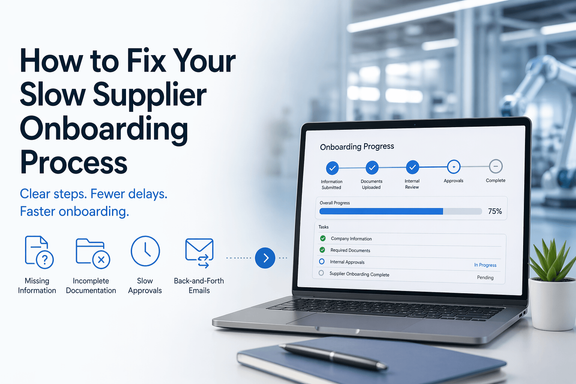
Supplier onboarding usually takes too long for a simple reason:
It is not actually being managed as one process.
Instead, it gets spread across procurement, quality, compliance, engineering, and the supplier itself. Everyone owns a piece. Nobody owns the whole flow. So progress depends on follow-up, inbox visibility, and whoever happens to notice what is missing.
That is why onboarding drags on.
Not because it is inherently complex. Because it is fragmented.
Supplier onboarding delays are usually process problems
Most companies treat supplier onboarding like an administrative task. A few forms. A few approvals. A few documents.
But that framing is exactly what creates the delay.
When onboarding is seen as “just paperwork,” it rarely gets the structure it needs. Requirements are not clear upfront. Ownership stays fuzzy. Suppliers are asked for information in stages instead of all at once. Internal reviewers respond when they get to it.
Then everyone wonders why a new supplier is still not fully onboarded three weeks later.
The problem is usually not effort. It is coordination.
Where supplier onboarding breaks down
In most teams, the delays are predictable.
1. Missing information
The supplier submits part of what is needed, but not all of it.
Maybe basic company data is complete, but contact details for the quality lead are missing. Maybe banking information is in place, but manufacturing site details are not. Maybe the commercial conversation moved ahead before the onboarding requirements were fully defined.
This creates a slow-motion start-stop process.
Instead of gathering all required information upfront, teams keep discovering gaps halfway through. That means more emails, more waiting, and more time lost between steps.
2. Incomplete documentation
This is one of the most common blockers.
Quality certificates, signed policies, process documents, questionnaires, audit records, insurance documents, compliance forms—some of them show up, some of them do not, and nobody has a clean view of what is still outstanding.
The issue is not that suppliers never send documents.
The issue is that the request is often unclear, inconsistent, or spread across multiple people. One team asks for one file. Another asks later for a different one. A third realizes a required document was never requested at all.
That is not a supplier problem. That is a workflow problem.
3. Slow approvals
Even when the supplier has submitted everything, onboarding can still stall internally.
Why?
Because approvals are often invisible.
A quality manager may need to review one set of documents. Procurement may need to approve commercial terms. Engineering may need to sign off on capability. Compliance may need to verify policies. But if there is no shared process, each approval step sits in a different inbox or meeting queue.
Nobody sees the delay until it becomes urgent.
And once it is urgent, the process turns into chasing.
4. Back-and-forth emails
Email is where onboarding workflows go to slow down.
The supplier sends one attachment. Someone internally replies with another request. Another stakeholder joins the thread and asks for a different format. A week later, nobody is fully sure which version is current, what is still missing, or whether the supplier already answered a previous request.
Email is fine for communication.
It is terrible as the operating system for supplier onboarding.
When onboarding lives in email, progress depends on memory and persistence instead of structure.
What actually speeds supplier onboarding up
The fix is not more follow-up.
The fix is building a process that needs less follow-up in the first place.
Start with a clear onboarding checklist
Every supplier onboarding process should begin with a defined list of required inputs, documents, and approvals.
Not a vague internal understanding. A real checklist.
That checklist should answer a few basic questions:
- What information must the supplier provide?
- What documents are required?
- Which teams need to review what?
- What are the approval steps?
- What qualifies a supplier as fully onboarded?
This sounds obvious. But many teams still run onboarding based on habit rather than a standard structure.
A checklist does two things immediately:
First, it reduces ambiguity for the supplier.
Second, it prevents your team from discovering requirements too late.
Define ownership across the process
One of the fastest ways to improve onboarding speed is to make one person responsible for progress.
That does not mean one person does all the work.
It means one person owns the process moving forward.
Without that, onboarding gets stuck between functions. Procurement assumes quality is handling the next step. Quality assumes compliance is reviewing. Compliance assumes the supplier has already responded. And the supplier is left waiting.
Clear ownership changes the dynamic.
It creates accountability for moving work across the finish line, not just completing individual tasks.
Let suppliers submit information through a structured process
One major source of delay is manual collection.
When suppliers are asked to send information over email, teams end up reformatting, re-uploading, renaming, and clarifying it manually. That creates unnecessary work before any real review even begins.
A better model is supplier self-service input inside a structured workflow.
That means suppliers can:
- see what is required
- submit the right information in the right place
- upload documentation directly
- understand what is still outstanding
This reduces confusion on both sides.
It also makes the process feel more professional. Suppliers are much more likely to respond quickly when the request is clear and centralized.
Make progress visible
Visibility is the difference between a manageable delay and a silent one.
If your team cannot see where onboarding stands, then every delay gets discovered late.
A better process makes status visible at a glance:
- what is complete
- what is missing
- what is waiting on the supplier
- what is waiting internally
- who owns the next step
That matters because most onboarding delays are not dramatic.
They are idle time.
A document waiting three days for review. A missing field nobody noticed. An approval step sitting quietly in someone's inbox.
Visibility turns those hidden delays into solvable ones.
A simple example of how delays pile up
Imagine a new supplier is being onboarded for a production program.
Commercial discussions are done. Everyone wants the supplier live quickly.
Procurement has collected the main business details. But quality documentation is incomplete. Engineering is waiting for one capability confirmation. Compliance still needs a signed policy. The supplier thinks they already submitted everything required because they answered the first email thread.
Now the process slows down.
Procurement follows up with the supplier.
Quality follows up separately.
The supplier sends documents to one person but not the others.
Engineering has no visibility into what is still pending.
A week later, leadership asks why onboarding is still open.
This is a very normal failure mode.
Not because anyone is incompetent. Because the workflow itself is weak.
A structured onboarding process would have exposed the missing items immediately, assigned owners to each step, and shown the exact blockers in one place.
Faster onboarding is not just an efficiency win
When supplier onboarding improves, the benefit is bigger than administrative speed.
You reduce risk.
You reduce confusion.
You reduce the chance that a supplier moves forward with unresolved gaps in quality, compliance, or capability.
You also improve supplier experience.
That matters more than many companies realize. A messy onboarding process tells a supplier that your organization is hard to work with. A clear process tells them expectations are serious, organized, and consistent.
That sets the tone for the relationship that follows.
The underlying issue is fragmentation
That is the real pattern behind slow onboarding.
Not too much work.
Too many disconnected steps.
Too many requests happening in different places.
Too little clarity on what is missing and who is waiting.
The teams that improve onboarding speed are usually not doing something revolutionary. They are just replacing fragmented coordination with a structured process.
That is the shift.
Where Supplios fits
This is exactly the kind of problem Supplios is built to help solve.
Instead of managing supplier onboarding across email threads, spreadsheets, and disconnected approvals, teams can run it through a shared workflow with clear requirements, ownership, supplier-facing input, and visible progress.
That does not just make onboarding faster.
It makes it easier to manage without constant chasing.
And that is usually the real goal.
Final thought
If your supplier onboarding process feels slow, do not start by asking people to follow up faster.
Start by asking where the process is fragmented.
That is usually where the delay is hiding.
Map your onboarding flow step by step and look for the waiting points.
Where is information missing?
Where are documents incomplete?
Where do approvals sit too long?
Where does email create unnecessary back-and-forth?
Fix those points, and onboarding gets faster without adding more pressure.