From Firefighting to Prevention: Building a Proactive Supplier Quality Function
How supplier quality teams can move from reactive issue handling to a more proactive, prevention-driven approach.

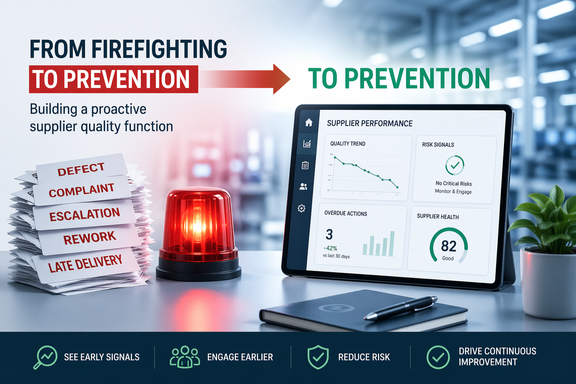
Many supplier quality teams operate in firefighting mode.
A defect shows up. A delivery slips. A customer complaint lands. Then the team reacts.
That response is necessary. But when most of the work happens after the problem appears, supplier quality becomes a function that absorbs pain instead of preventing it.
That is where many teams get stuck.
Not because they are weak. Not because they do not care. But because their systems, workflows, and information are built for reaction.
Firefighting feels productive. It is still a trap.
Firefighting creates motion.
There are calls. Escalations. Corrective actions. Follow-ups. Supplier emails. Internal meetings. Status updates.
It can feel like the team is doing important work all day, because they are. The problem is that reactive work expands to fill all available time.
When supplier quality is overloaded with incidents, there is no room left for pattern recognition, supplier development, or early intervention. The team becomes very good at handling issues that should have been prevented.
That is not a people problem. It is an operating model problem.
Why supplier quality becomes reactive
Most reactive supplier quality environments share the same root causes.
1. Limited visibility
Teams often do not have a clear view of what is changing across suppliers over time.
They may know the latest issue. They may know which supplier is currently escalated. But they cannot easily see trendlines across nonconformances, response times, recurring defects, overdue actions, or weak audit follow-through.
Without visibility, every issue looks isolated.
2. Fragmented information
Critical supplier quality information is usually scattered.
Some of it lives in email. Some in spreadsheets. Some in ERP fields. Some in audit files. Some in people’s heads.
When information is fragmented, the team spends its time reconstructing the current state instead of acting on it. That slows response in the short term and makes prevention nearly impossible in the long term.
3. Processes that start too late
In many organizations, supplier quality workflows begin only after something has already gone wrong.
A complaint is filed. A plant escalates. A customer gets affected. Then the corrective action process begins.
That means the system is designed to respond to failures, not to catch warning signs before failure.
4. No early warning signals
A proactive function needs signals.
Not just incidents. Signals.
Repeated minor deviations. Slipping supplier responsiveness. Open actions piling up. Audit findings that keep reappearing. Delivery and quality performance moving in the wrong direction at the same time.
When those signals are not visible, teams only act when the issue becomes too large to ignore.
What proactive supplier quality actually looks like
A proactive supplier quality function is not one with fewer problems.
It is one that sees problems earlier.
That is the real shift.
Proactive teams do a few things differently:
- They track trends across suppliers, not just isolated events
- They monitor supplier performance continuously, not occasionally
- They engage suppliers earlier, before issues become urgent
- They make decisions using shared, current information instead of manual follow-up
This does not require a dramatic reorganization. In most cases, it requires better operating discipline and better visibility.
Four practical shifts from reaction to prevention
The move to prevention usually starts with a handful of concrete changes.
1. Track recurring patterns, not just individual incidents
Most supplier issues are not truly random.
The same suppliers appear again. The same categories of defects return. The same corrective actions stall. The same communication gaps create delays.
But if each issue is handled in isolation, those patterns stay hidden.
A more proactive team looks across incidents and asks:
- Which suppliers are repeatedly creating noise?
- Which issue types are trending up?
- Where do actions keep getting delayed?
- Which sites or commodities are exposed to the same recurring risks?
The goal is to move from case management to pattern detection.
2. Review supplier performance continuously
Many companies have scorecards, but they use them too infrequently to drive behavior.
A supplier can drift for weeks or months before the issue becomes visible in a formal review. By then, the team is already in response mode.
Proactive quality teams monitor performance continuously enough to notice deterioration early.
That does not mean overengineering a dashboard for everything. It means keeping a close view on a few practical indicators that matter, such as:
- quality incidents
- repeat defects
- response times
- overdue corrective actions
- audit follow-up progress
- delivery and quality trends together
The objective is not reporting for its own sake. It is earlier intervention.
3. Engage suppliers before escalation becomes necessary
Too many supplier conversations happen late.
The supplier hears from the customer only when the issue is already serious, internal frustration is high, and the timeline is compressed.
That is not a strong foundation for improvement.
A prevention-oriented team engages suppliers earlier, when signals start to appear. That may mean raising concerns sooner, clarifying expectations faster, or reviewing open risks before they become escalations.
Early engagement is often the difference between a manageable correction and a full-blown crisis.
4. Improve data visibility across the workflow
This is usually the biggest unlock.
If the team cannot see what is open, what is late, what is recurring, and where supplier performance is shifting, prevention stays theoretical.
Good supplier quality work depends on shared visibility:
- what issues are active
- who owns the next step
- which suppliers are trending in the wrong direction
- where actions are overdue
- what has actually been resolved versus merely acknowledged
Without that visibility, teams compensate with meetings, inboxes, and manual follow-up.
That is expensive. And it does not scale.
Prevention is mostly an information problem
A lot of teams assume they need more effort to become proactive.
Usually, they need better information first.
That distinction matters.
Most supplier quality organizations already work hard. The issue is that their effort is being consumed by low-visibility, manually coordinated workflows. They spend too much time chasing status, collecting updates, and piecing together context after the fact.
Prevention becomes possible when the team can see what is changing early enough to act.
That is why the shift from firefighting to prevention is not mainly about working harder. It is about making supplier quality visible enough to manage upstream.
Where Supplios fits
This is exactly where a structured supplier quality system becomes valuable.
Supplios helps teams move supplier quality work out of scattered emails and disconnected spreadsheets into shared workflows with clear visibility. Instead of managing issues, follow-ups, supplier input, and performance signals across different places, teams can work from one current view of what is happening.
That matters because proactive supplier quality depends on seeing patterns early, not just documenting incidents after they happen.
When the workflow is visible, prevention becomes realistic.
The real question to ask your team
Most supplier quality teams do not choose firefighting mode. They inherit it.
The better question is not whether your team is busy.
It is whether that effort is preventing future problems or only reacting to current ones.
Look at the last 30 days of work.
How much of it reduced risk before failure? And how much of it only started after something had already gone wrong?
That answer will tell you whether your supplier quality function is truly proactive.