Poor Supplier Master Data: A Looming Risk for Supplier Quality
Poor supplier master data creates quality, compliance, and decision-making risks that manufacturing teams can no longer afford to treat as admin work.

Most companies treat supplier master data like back-office maintenance.
Something administrative. Something boring. Something to clean up later.
That is a mistake.
Poor supplier data is not just an efficiency problem. It is a supplier quality problem.
When supplier records are inaccurate, outdated, or fragmented across systems, quality teams move slower, make weaker decisions, and expose the business to avoidable risk. Wrong contacts delay response times. Missing certifications create compliance gaps. Inconsistent records distort supplier performance and make it harder to see where the real problems are.
Good supplier quality decisions depend on good supplier data. If the underlying information is unreliable, the process built on top of it becomes unreliable too.
Supplier data directly affects quality performance
Supplier quality teams rely on master data more than many organizations realize.
Not in theory. In daily operations.
Every time a team needs to raise a corrective action, escalate an issue, review supplier compliance, schedule an audit, or assess supplier performance, they depend on accurate supplier information. They need to know who the supplier is, which site is involved, who owns the relationship, what certifications are current, and what status or risk profile the supplier has.
If that information is wrong, the process slows down immediately.
A quality issue gets routed to the wrong person. A supplier site gets confused with another location. A certification appears valid because no one updated the record. A performance review gets skewed because one supplier exists in the system three different ways.
This is how bad data quietly becomes operational risk.
What poor supplier master data actually looks like
Most teams do not describe the problem as “poor master data.”
They feel it in the form of everyday friction.
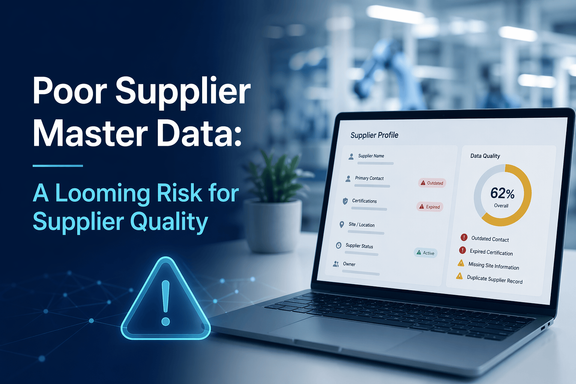
It shows up as duplicate supplier records, outdated contacts, missing fields, inconsistent naming conventions, expired certifications that remain on file, and disconnected systems that all hold slightly different versions of the truth.
Sometimes the problem is simple: the main supplier contact left months ago, but their details are still attached to active workflows.
Sometimes it is more serious: a plant is working with one supplier site while the system record points to another, creating confusion in audits, escalations, or scorecards.
And sometimes the damage is invisible until it matters. A supplier appears fully approved until someone notices a required certification expired weeks ago and was never reviewed.
The issue is not just that the data is messy.
It is that people are making decisions based on it.
The real cost is slower response and weaker decisions
The first cost of poor supplier data is speed.
When a quality issue happens, teams need to react fast. They need the right supplier contact, the right site information, the right escalation path, and the right compliance context. If that data is missing or wrong, everything takes longer.
Now the team is chasing email addresses. Confirming who owns the supplier relationship. Checking spreadsheets. Asking procurement which record is correct. Digging through attachments to confirm whether a certificate is current.
That is not supplier quality work. That is recovery work caused by weak data.
The second cost is decision quality.
Supplier performance management only works when supplier data is trustworthy. If scorecards are built on duplicate records, outdated supplier mappings, or incomplete documentation, the output looks structured but tells the wrong story.
A supplier may seem low risk because important issues are spread across multiple records.
Another may look worse than they are because performance is tied to the wrong site or business unit.
Once the data is weak, the reporting becomes weaker. And once the reporting is weak, prioritization gets worse.
Compliance gaps often start with bad records
This is where the problem becomes harder to dismiss.
Missing or outdated supplier data does not just create inconvenience. It can create compliance exposure.
If required certifications are not maintained correctly, teams can assume a supplier remains compliant when they are not.
If audit status is not updated consistently, follow-up actions can slip.
If documentation is stored across inboxes, shared drives, and spreadsheets, no one has confidence that the latest version is actually the latest version.
Most compliance failures do not begin with dramatic mistakes.
They begin with unreliable records, weak ownership, and too much manual checking.
That is why supplier master data should not sit outside the quality conversation. It is part of the quality system whether companies treat it that way or not.
Why this keeps happening
The root problem is usually not laziness.
It is ownership.
Supplier data often sits between procurement, supplier quality, operations, and sometimes a separate master data or ERP team. Everyone touches it. No one fully owns it.
Updates happen manually. One team changes a contact in one system. Another stores a new certificate in a folder. A third updates a spreadsheet used for reporting. Nothing is fully connected, and no one is responsible for making sure the whole picture stays accurate.
Over time, the gaps compound.
The systems multiply. The workarounds grow. The trust in the data drops.
And once teams stop trusting the data, they build shadow processes around it — personal spreadsheets, email trails, local trackers, and manual checks.
That makes the original problem worse, not better.
What better looks like
The fix is not “clean up the data once.”
The fix is to make supplier data governable.
That starts with centralization. Supplier quality teams need one reliable place to work from, not five partial records spread across different tools.
It also requires defined ownership. Someone must be accountable for key supplier fields being correct — especially contacts, certifications, supplier status, site information, and ownership.
Then comes routine validation. Supplier data should be reviewed and updated as part of operational workflows, not as a one-time project. Certifications expire. Contacts change. Supplier structures evolve. The data has to keep moving with reality.
Strong teams also reduce opportunities for inconsistency. They standardize fields, structure updates, and make it easier to see what changed, who changed it, and what still needs review.
This is not glamorous work.
But it is foundational work.
Supplier quality runs on trusted information
The best supplier quality teams do not separate process quality from data quality.
They understand that response speed, compliance confidence, and supplier performance visibility all depend on the same thing: trusted information.
That is one reason teams move away from managing supplier workflows through scattered email threads and disconnected spreadsheets. Those tools make it far too easy for supplier information to drift, duplicate, and disappear into local workarounds.
Supplios helps solve this by giving teams a shared place to manage supplier workflows, communication, documentation, and follow-up visibility. When supplier interactions and records live in one operational system, it becomes much easier to keep information current and much harder for critical details to get lost.
You do not need perfect data to improve supplier quality.
But you do need data you can trust.
Final thought
Bad supplier data creates slow decisions, weak follow-up, and hidden compliance risk.
That is not an admin issue.
That is a supplier quality issue.
If your team is constantly double-checking contacts, hunting for certifications, or working around inconsistent supplier records, the real problem may not be the process.
It may be the data underneath it.
Review your supplier data today: how much of your supplier quality process is running on information you actually trust?