Still using email to manage supplier quality? Here’s how to change that
Why email breaks down for supplier quality workflows like SCARs and audits, and what to use instead for better visibility, tracking, and supplier follow-up.

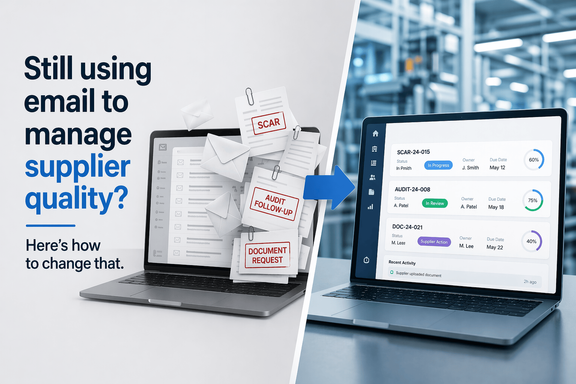
Email works until the process actually matters.
That is the real problem.
For supplier quality, email often becomes the default system for SCARs, audit follow-up, document collection, and supplier communication. It feels easy because everyone already has it. No training. No rollout. No new process to explain.
But that convenience hides a bigger issue: email is a communication tool, not a system of record.
And once supplier quality starts depending on it, things get messy fast.
Why email fails in supplier quality
Supplier quality work is not just about sending messages.
It is about moving issues from open to closed. It is about assigning ownership, tracking deadlines, collecting evidence, keeping a clear history, and making sure both your team and the supplier know what happens next.
Email is not built for that.
An inbox shows conversation. It does not show workflow.
That sounds like a small difference, but in practice it is huge.
A SCAR is not just “an email thread.” An audit finding is not just “something we sent to the supplier last week.” A document request is not complete just because somebody hit send.
These are operational processes. They need structure.
The problems teams start treating as normal
When supplier quality runs through email, a lot of dysfunction starts to feel routine.
1. No one has real visibility
One engineer may know the status because the latest reply is sitting in their inbox.
Everyone else is guessing.
A manager asks for an update. Someone searches through old threads. Another person forwards the “latest version.” A supplier has replied, but only one internal person saw it. Suddenly the whole team is working off partial information.
That is not visibility. That is inbox dependency.
2. Attachments and versions get out of control
A supplier sends an 8D report. Then a revised version. Then another one with a small correction.
Which file is the final version?
Which one was reviewed internally?
Which one was sent back with comments?
In email, documents get scattered across attachments, forwards, downloads, and local folders. Even disciplined teams end up with version confusion because the process itself is unstructured.
3. Tracking is manual
Email has no built-in workflow for supplier quality.
So teams create one by hand.
They build spreadsheets to log open SCARs. They flag emails. They add calendar reminders. They maintain side lists of audit findings. They send “just checking in” messages because nothing in the process follows up automatically.
This is where supplier quality teams lose time they never get back.
Not on solving the issue itself.
On managing the chaos around it.
4. Follow-up becomes somebody’s memory
A surprising amount of supplier quality runs on individual persistence.
Someone remembers to chase the supplier. Someone remembers the due date. Someone remembers which plant asked for what. Someone remembers that the corrective action was still incomplete.
That works until that person is out sick, overloaded, or leaves the company.
A real process should not live in somebody’s memory or inbox.
5. Suppliers get fragmented requests
This gets even worse in multi-site organizations.
Different people reach out from different plants. Requests overlap. Expectations vary. Deadlines are unclear. The supplier ends up managing your internal inconsistency for you.
From their side, it looks disorganized.
And that matters. Because supplier quality is not just about internal control. It is also about creating a clear and workable way for suppliers to respond.
Why teams stay stuck on email anyway
If email is so obviously flawed, why do so many teams still use it?
Because email is familiar.
It does not feel like a system decision. It feels like the path of least resistance.
Most teams do not sit down and choose email as their supplier quality platform. They just inherit it. Then they build workarounds on top of it.
A spreadsheet here. A shared folder there. A naming convention for attachments. A weekly status meeting to compensate for missing visibility.
The result is a patchwork process that technically functions, but only through effort and discipline.
That is why teams stay stuck longer than they should. The pain is real, but incremental. There is no single dramatic failure. Just constant friction.
And constant friction is easy to normalize.
What should replace email
The answer is not “use email better.”
The answer is to move supplier quality workflows into a structured environment.
That means a few things.
Structured workflows
SCARs, audits, onboarding tasks, document collection, and supplier follow-up should have defined records, statuses, owners, and due dates.
Not vague email chains.
A process should show where something stands without requiring someone to explain it.
Shared visibility
Anyone who needs the status should be able to see it.
Not by asking around. Not by being cc’d on everything. Not by digging through forwarded threads.
The team should know:
- what is open
- who owns it
- what is overdue
- what the supplier has submitted
- what still needs review
That visibility changes how quickly teams can act.
Supplier interaction in one place
Suppliers should not have to decode fragmented requests from multiple people across scattered messages.
The cleaner approach is one shared workflow where the communication, required actions, due dates, and supporting documents are tied together.
That reduces confusion for both sides.
And when suppliers know exactly what is needed and where to respond, follow-up gets easier.
What changes when you stop using email as the workflow
This is where teams usually see the difference quickly.
Response times improve because nothing is hiding in an inbox.
Accountability improves because ownership is visible.
Traceability improves because the full history stays attached to the actual issue, audit, or request.
Managers stop asking for manual status updates because the status is already there.
And the whole process becomes less dependent on heroic individual effort.
That matters even more as companies grow.
A team can survive email-based supplier quality when volumes are low and the same people know everything.
It breaks when supplier count increases, plants multiply, responsibilities spread, and the cost of inconsistency gets higher.
At that point, email does not just feel inefficient.
It becomes a scaling problem.
Where Supplios fits
This is exactly the gap Supplios is built to close.
Instead of managing SCARs, audit follow-up, and supplier requests across inboxes, spreadsheets, and shared drives, teams can run those workflows in one structured system.
That means:
- supplier quality issues tracked with clear ownership and status
- audit findings managed in a shared workflow
- supplier communication tied to the actual record
- documentation stored with the issue instead of buried in attachments
- visibility across teams and plants without constant manual coordination
The point is not to eliminate communication.
The point is to stop pretending communication is the process.
Email is a tool, not a supplier quality system
Email still has a place.
It is useful for quick communication. It is useful for introductions. It is useful for simple back-and-forth.
But it is a poor foundation for operational quality workflows.
If your team is still managing SCARs, audits, supplier documentation, and follow-up through inboxes, the issue is not just inconvenience. It is lack of process clarity.
And that usually shows up as slower response times, weaker visibility, and more manual work than anyone wants to admit.
Identify which supplier processes still rely heavily on email. That is usually where your biggest supplier quality bottlenecks are hiding.