Supplier portal vs. Supplier Operations Platform: What manufacturers actually need
Learn the difference between a basic supplier portal and a Supplier Operations Platform, and why manufacturers need more than document uploads and supplier logins to manage supplier quality, onboarding, supplier data, scorecards, and performance improvement.

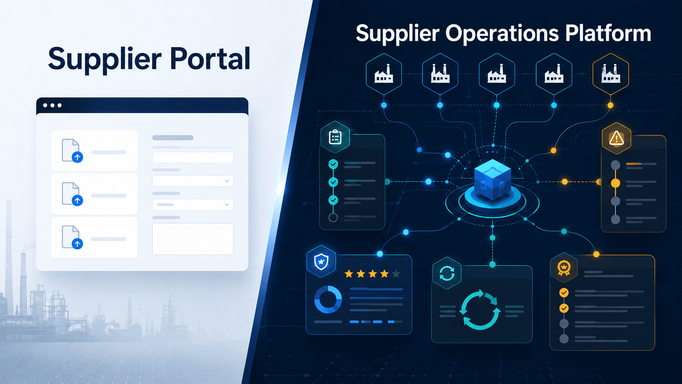
Most manufacturers already have some version of a supplier portal.
It might be part of an ERP system. It might be a standalone vendor portal. It might be a shared document process with a login page. It might even be a set of spreadsheets, email templates, and folders that everyone informally treats as “the portal.”
For years, that was enough to make supplier collaboration feel more digital. Suppliers could log in. Documents could be uploaded. Forms could be submitted. Internal teams could reduce some email traffic.
But many purchasing and supplier quality teams have learned the hard way that giving suppliers a place to submit information is not the same as managing supplier operations.
A portal can collect a document. It does not necessarily make sure the document is reviewed, approved, renewed, escalated, or connected to the right supplier workflow.
A portal can capture supplier information during onboarding. It does not necessarily keep that information accurate six months later.
A portal can display a supplier scorecard. It does not necessarily drive the follow-up actions needed to improve supplier performance.
A portal can receive a quality claim response. It does not necessarily manage immediate actions, containment, root cause analysis, corrective actions, and verification in a disciplined process.
That gap is why a new category is emerging: the Supplier Operations Platform.
A Supplier Operations Platform is not just a nicer supplier portal. It is a system for managing the operational work that happens between manufacturers and their suppliers across purchasing, supplier quality, supplier onboarding, supplier data, claims, scorecards, and performance improvement.
The distinction matters because supplier collaboration is not a static information exchange. It is ongoing operational work.
What is a simple supplier portal?
A simple supplier portal is usually designed as a digital access point for suppliers.
It gives suppliers a place to log in and complete basic tasks, such as:
- submitting company information
- uploading documents
- accessing forms or policies
- viewing purchase-related information
- responding to requests from the customer
- maintaining a basic supplier profile
There is nothing wrong with this. In fact, supplier portals were an important improvement over fully manual processes. They helped move supplier communication out of scattered inboxes and gave suppliers a central place to interact with their customers.
For some companies, a simple portal may still be enough. If the supplier relationship is low-complexity, the required documentation is limited, and the internal process is straightforward, a portal can provide value.
The problem is that many manufacturing supplier relationships are not simple.
Industrial and automotive suppliers are often tied to production-critical parts, quality documentation, compliance requirements, audits, engineering changes, performance reviews, claims, corrective actions, and cross-functional collaboration between purchasing, supplier quality, operations, logistics, and engineering.
In that environment, the portal is only the front door.
The real question is what happens after the supplier logs in.
Where basic supplier portals start to fall short
Supplier portals often fall short because they are designed around submission, not execution.
They answer the question: “Where should the supplier put the information?”
But manufacturing teams need answers to more operational questions:
- Who is responsible for reviewing this?
- Is the supplier response complete?
- What information is missing?
- Has the right internal owner approved it?
- What needs follow-up?
- What is overdue?
- Which suppliers are creating risk?
- What actions are being taken to improve performance?
- Where does the supplier relationship stand today?
These questions are not solved by a static portal alone.
They require workflows, ownership, visibility, task management, supplier participation, and follow-through.
They collect data, but do not keep it accurate
Supplier data changes constantly.
Contacts change. Quality contacts move roles. Bank information may need verification. Certificates expire. Production sites change. Capabilities evolve. Compliance documents need renewal. Supplier ownership structures can change. New contacts need access while old contacts need to be removed.
A traditional supplier portal may capture the information once during onboarding. But the operational challenge is keeping that information accurate over time.
Many manufacturers still rely on buyers, SQEs, or supplier managers to manually chase suppliers for updates. They send emails asking suppliers to confirm whether the information is still correct. They maintain spreadsheets to track who responded. They update systems manually. They hope the data is still reliable when the business needs it.
That is not really supplier data management. It is supplier data cleanup.
A Supplier Operations Platform should support the full lifecycle of supplier data. That means onboarding new suppliers, requesting the right information, assigning suppliers recurring data update or confirmation tasks, tracking completion, and giving internal teams visibility into what is current and what is not.
The difference is important.
A portal stores supplier data.
A Supplier Operations Platform helps keep supplier data operationally usable.
They do not manage the workflow around the data
A supplier uploading a document is only one step in a process.
Someone may need to review it. Someone may need to reject it. Someone may need to request a correction. The document may need an expiration date. The system may need to trigger reminders before it expires. A manager may need visibility into suppliers that are missing critical documentation.
In a basic portal, this workflow often happens outside the system.
The supplier uploads the file, but the review happens by email. The buyer tracks status in a spreadsheet. The supplier quality engineer follows up separately. A manager asks for a status update in a meeting. Someone downloads the document and saves it in a shared folder.
The portal exists, but the work still happens around it.
This is one of the clearest signs that a manufacturer has outgrown a basic supplier portal. The system may be useful as a repository, but it is not functioning as the operating layer for supplier work.
They often support one function, not the supplier relationship
Supplier work is cross-functional by nature.
Purchasing cares about commercial terms, responsiveness, onboarding, and supplier performance.
Supplier quality cares about claims, corrective actions, certifications, production readiness, and quality documentation.
Supply chain cares about continuity, delivery performance, and supplier risk.
Operations cares about whether suppliers can support production reliably.
A basic portal is often designed around one slice of this relationship. It may support procurement transactions but not supplier quality workflows. Or it may support onboarding but not ongoing performance management. Or it may collect documents but not drive corrective action.
That creates fragmentation.
The supplier experiences one customer through multiple disconnected processes. Internally, teams build their own trackers, inbox rules, spreadsheets, and reporting habits. No one has a complete view of what is happening with the supplier.
A Supplier Operations Platform should bring more of this work into one shared operating environment.
Not because every team needs the exact same workflow, but because supplier operations are connected. The same supplier may be going through onboarding, responding to a quality claim, updating compliance documents, and working through scorecard improvement actions at the same time.
Teams need a shared view of that reality.
Suppliers may not actually use them
A supplier portal only works if suppliers use it.
Many portals fail because they are too hard to navigate, too disconnected from actual requests, or too unclear about what the supplier needs to do next.
Suppliers are often working with many customers, each with its own portal, process, format, and login. If the experience is confusing, suppliers fall back to the lowest-friction channel: email.
That creates duplicate work for everyone.
The internal team still has to chase suppliers. Suppliers still ask where to send documents. Buyers still forward attachments. Supplier quality teams still manage claims in email threads. Managers still lack visibility.
A Supplier Operations Platform needs to be supplier-friendly, not just internally powerful. The supplier should understand what is being requested, why it matters, when it is due, and what action is expected.
Good supplier adoption is not just a user experience issue. It is an operational requirement.
What is a Supplier Operations Platform?
A Supplier Operations Platform is software that helps manufacturers manage the operational work that happens between internal teams and suppliers.
It is broader than a supplier portal because it is not only focused on supplier access or document submission. It is designed to support the workflows, tasks, data, communication, follow-up, and visibility required to manage supplier relationships in practice.
A Supplier Operations Platform helps manufacturers answer questions like:
- Which suppliers are fully onboarded?
- Which supplier records need to be updated or confirmed?
- Which quality claims are waiting on supplier action?
- Have immediate actions and containment been completed?
- Has root cause analysis been submitted and reviewed?
- Are corrective actions verified?
- Which suppliers are underperforming on their scorecards?
- What improvement actions are open?
- Who owns each follow-up?
- Where are supplier-related bottlenecks forming?
This is the category distinction.
A supplier portal gives suppliers a place to interact.
A Supplier Operations Platform helps manufacturers run supplier-facing operations.
The supplier may still interact through a portal-like experience. But the system behind it is doing more than collecting inputs. It is helping internal teams and suppliers move work forward.
The practical difference: access point vs. operating layer
The simplest way to understand the difference is this:
A supplier portal is an access point.
A Supplier Operations Platform is an operating layer.
An access point is useful. It gives suppliers a place to go.
But an operating layer manages what needs to happen next. It connects supplier inputs to internal ownership, task status, workflow steps, approvals, deadlines, and follow-up actions.
This distinction becomes especially clear in three common manufacturing workflows: supplier quality claims, supplier onboarding and data management, and supplier scorecards.
Example 1: Supplier quality claims management
Supplier quality claims are a good test of whether a system is just collecting information or actually managing supplier operations.
In a basic supplier portal, the workflow might look like this:
A quality issue is documented internally. The supplier is notified. The supplier logs in and submits a response or uploads a document. Internal teams then continue the process through email, meetings, spreadsheets, and manual follow-up.
That may digitize part of the claim process, but it does not necessarily manage the claim.
Supplier Quality Claims management requires more than a submission box. It needs a structured process for documenting the issue, driving immediate actions, managing containment, collecting root cause analysis, reviewing corrective actions, and following up on verification.
In a Supplier Operations Platform, the workflow should support the actual way supplier quality teams work.
A supplier quality claim may involve:
- documenting the claim clearly
- assigning the supplier immediate actions
- requesting containment steps
- tracking deadlines and overdue responses
- collecting root cause analysis
- reviewing proposed corrective actions
- assigning internal responsibility for review
- following up on verification of corrective actions
- maintaining visibility into open claims and supplier responsiveness
This matters because quality claims are not just records. They are operational events.
A late containment response can create production risk. A weak root cause analysis can allow the issue to repeat. An unverified corrective action can give the appearance of closure without actual confidence that the problem has been solved.
A basic portal may help receive supplier responses.
A Supplier Operations Platform helps drive the claim to resolution.
Example 2: Supplier onboarding and data management
Supplier onboarding is another area where the difference becomes clear.
Many supplier portals treat onboarding as a one-time data collection exercise. The supplier fills out a form, uploads documents, submits banking details, provides contacts, and waits for approval.
That is useful, but incomplete.
For manufacturers, onboarding is not just about creating a supplier record. It is about making sure the supplier is ready to work with the business.
That may include commercial information, tax details, quality contacts, production site information, certifications, compliance documentation, capabilities, approval workflows, and internal review steps.
A Supplier Operations Platform should help coordinate this process from request to completion.
It should make clear what the supplier needs to provide, what internal teams need to review, which steps are complete, which steps are blocked, and whether the supplier is ready for use.
But the larger issue comes after onboarding.
Supplier data must stay current.
A supplier record that was accurate on day one can become unreliable over time. Contacts leave. Certificates expire. Company details change. Quality contacts are replaced. Documents need renewal. If no one actively manages that data, the system slowly loses trust.
Once internal teams stop trusting the supplier data, they create workarounds. Buyers keep their own contact lists. SQEs maintain separate trackers. Compliance documents live in folders. Supplier updates happen through individual inboxes.
At that point, the company may technically have a supplier portal, but it does not have reliable supplier data management.
A Supplier Operations Platform treats supplier data as an ongoing operational responsibility. For example, suppliers can be assigned recurring data update and confirmation tasks. Internal teams can see whether suppliers have confirmed their information. Missing or outdated data can become visible instead of hidden.
This changes the role of the system.
A portal asks suppliers to enter data.
A Supplier Operations Platform helps maintain supplier data as a living operational asset.
Example 3: Supplier scorecards and performance management
Supplier scorecards are often where the gap between visibility and action becomes obvious.
Many manufacturers produce supplier scorecards. They may track delivery performance, quality performance, responsiveness, claims, commercial metrics, or other indicators. The scorecard may be shared with suppliers monthly or quarterly.
That visibility is valuable.
But visibility alone does not improve supplier performance.
The hard part is what happens after the scorecard identifies a problem.
If a supplier is underperforming in quality, delivery, responsiveness, or another area, someone needs to define the action required. The supplier needs to understand the issue. Internal teams need to align on expectations. Tasks need owners and deadlines. Progress needs to be tracked. Follow-up needs to happen.
In many companies, this part of the process is handled manually.
The scorecard is generated in one system. The improvement discussion happens in a meeting. Actions are captured in notes or spreadsheets. Follow-up happens through email. By the next review cycle, it is not always clear what changed, what was completed, or what is still open.
That is the difference between scorecard reporting and performance management.
A Supplier Operations Platform should help manufacturers move from “Here is the score” to “Here is what we are doing about it.”
For example, when a scorecard identifies an area needing improvement, the platform should help drive the actions that come from that finding. Those actions may involve the supplier, the buyer, the SQE, or another internal owner. The point is to connect performance visibility with operational follow-through.
A portal may show the supplier a scorecard.
A Supplier Operations Platform helps manage the improvement actions that come from it.
Why this matters more in manufacturing
The difference between a simple portal and a Supplier Operations Platform matters in any industry, but it matters especially in industrial and automotive manufacturing.
Manufacturing supplier relationships are operationally intensive. Suppliers are not just vendors in a database. They provide production materials, components, services, tooling, and capabilities that can affect quality, delivery, cost, and customer commitments.
A supplier issue can quickly become a production issue.
A missing document can delay approval.
A stale contact record can slow down an urgent escalation.
A weak corrective action can allow a defect to repeat.
An unmanaged scorecard action can leave performance problems unresolved.
A slow onboarding process can delay sourcing decisions or launch readiness.
This is why supplier collaboration cannot be treated as a passive portal experience. The work is too important, too cross-functional, and too dynamic.
Manufacturers need systems that help them manage supplier work with the same operational discipline they expect in other parts of the business.
The hidden cost of “portal plus email”
Many companies believe they have solved supplier collaboration because they have a portal.
But when you look closer, the real operating model is often “portal plus email.”
The portal is where information is submitted. Email is where the work gets done.
That creates several problems.
First, work becomes hard to track. A supplier response may be buried in one person’s inbox. A corrective action may be discussed in a thread that a manager cannot see. A document may be uploaded, but the review status may live somewhere else.
Second, ownership becomes unclear. When a task lives in email, it is easy for teams to lose sight of who owns the next step.
Third, reporting becomes unreliable. If workflows are happening outside the system, leadership cannot easily see bottlenecks, overdue tasks, supplier responsiveness, or process health.
Fourth, suppliers get an inconsistent experience. They may be asked to use the portal for one request, reply by email for another, and send documents to a shared inbox for a third.
Over time, the company ends up with more software but not necessarily more control.
A Supplier Operations Platform is meant to reduce this fragmentation. It gives teams a more structured way to manage supplier-facing work without forcing everything into informal follow-up channels.
How to know when you have outgrown a basic supplier portal
A simple supplier portal may be enough at an early stage. But most manufacturers eventually reach a point where the portal no longer supports the complexity of the work.
Common signs include:
- supplier data is spread across ERP, email, spreadsheets, and shared folders
- internal teams do not fully trust supplier contact or document data
- buyers and SQEs manually chase suppliers for updates
- onboarding status is unclear without asking several people
- supplier quality claims are tracked through spreadsheets or email threads
- containment, root cause analysis, and corrective action follow-up are inconsistent
- supplier scorecards are created, but improvement actions are not managed well
- suppliers complain that requests are unclear or duplicated
- managers lack visibility into open supplier tasks and bottlenecks
- the supplier portal exists, but most real work still happens outside it
The key signal is not whether a portal exists.
The key signal is whether the portal is actually helping the organization run supplier work.
If the answer is no, the company probably needs more than a supplier portal.
What to look for in a Supplier Operations Platform
A Supplier Operations Platform should not just add more screens. It should make supplier work easier to manage.
The most important capabilities are operational, not cosmetic.
Supplier workflows that match real work
Manufacturers need workflows that reflect how supplier work actually happens.
Supplier quality claims need documentation, supplier action, containment, root cause analysis, corrective action, review, and verification.
Supplier onboarding needs structured data collection, internal review, supplier completion tracking, and clear status visibility.
Supplier scorecards need more than reporting. They need action management when performance issues are identified.
The platform should help teams run these workflows in a consistent way while still allowing enough flexibility for real supplier situations.
Supplier data that stays current
Supplier data should not be treated as something collected once and forgotten.
A Supplier Operations Platform should make it easier to request updates, assign confirmation tasks, track completion, and maintain confidence in supplier records over time.
This is especially important when supplier data supports quality, compliance, purchasing, and operational decision-making.
Clear ownership and accountability
Supplier work often breaks down because the next step is unclear.
A good platform should make ownership visible. Suppliers should know what they owe. Internal users should know what they need to review or approve. Managers should be able to see what is overdue or blocked.
This sounds basic, but it is one of the biggest differences between a passive portal and an operational platform.
Cross-functional visibility
Supplier work rarely belongs to one department.
Purchasing, supplier quality, supply chain, operations, and sometimes engineering all need visibility into supplier status, open actions, claims, documentation, and performance improvement.
A Supplier Operations Platform should help teams see the supplier relationship more clearly across functions.
That does not mean everyone needs access to everything. It means the system should reduce the fragmentation that happens when each team manages supplier work separately.
A supplier-friendly experience
Suppliers are more likely to participate when the system is clear and easy to use.
They should be able to understand what is required, what the deadline is, what information they need to provide, and what status their response is in.
A platform that is powerful internally but painful for suppliers will struggle to become the real operating layer.
Supplier adoption matters because supplier operations are collaborative by definition.
Practical implementation
Manufacturing teams do not need another long, risky software project that takes years to create value.
A Supplier Operations Platform should be practical to start, focused on real workflows, and capable of improving day-to-day execution without requiring the organization to redesign everything at once.
The goal is not to replace every existing system. In many cases, the goal is to create a better collaboration and execution layer around supplier-facing work.
Supplier portals are not bad. They are incomplete.
It is worth being clear: supplier portals are not the enemy.
The problem is not that portals exist. The problem is when companies expect a basic portal to solve operational problems it was never designed to solve.
A portal can be a useful front end. It can help suppliers submit information and interact digitally with the customer.
But supplier operations require more than submission.
They require process ownership, structured collaboration, task management, status visibility, follow-up, and continuous improvement.
That is why the market needs a broader category.
A Supplier Operations Platform includes the supplier-facing experience, but it goes further. It helps manufacturers manage the work behind that experience.
The shift: from supplier self-service to supplier operations
Many supplier portals were built around the idea of supplier self-service.
Self-service is useful. Suppliers should be able to submit information, update records, access requests, and respond without unnecessary back-and-forth.
But supplier relationships are not fully self-service.
A quality claim cannot simply be “self-served” by the supplier. It needs review, discipline, containment, root cause analysis, and verification.
Supplier onboarding cannot simply be a form submission. It needs internal approval, data quality, document review, and readiness checks.
Supplier performance cannot simply be displayed in a scorecard. It needs discussion, action, accountability, and follow-up.
The next stage of supplier software is not just about giving suppliers access.
It is about helping manufacturers and suppliers operate together more effectively.
That is the role of a Supplier Operations Platform.
Where Supplios fits
At Supplios, we identify as a Supplier Operations Platform because we believe manufacturers need more than a basic supplier portal.
Supplier collaboration is not just a communication problem. It is an operations problem.
Supplios is built around practical supplier workflows such as Supplier Quality Claims management, Supplier Onboarding and data management, and Supplier Scorecards and Performance Management.
That means supporting the work that happens after a supplier logs in:
- documenting supplier quality claims
- driving suppliers for immediate actions and containment
- managing root cause analysis and corrective action follow-up
- verifying corrective actions
- onboarding new suppliers
- keeping supplier data up to date through recurring update and confirmation tasks
- managing supplier scorecards
- driving actions from areas identified as needing improvement
The goal is not to create another disconnected system. The goal is to help purchasing, supplier quality, and supply-chain teams manage supplier work with more clarity, consistency, and follow-through.
A Supplier Operations Platform should make supplier collaboration more operational, not more complicated.
The portal is the starting point, not the destination
A supplier portal can be useful. It gives suppliers a digital place to interact with the business.
But for manufacturers managing complex supplier relationships, the larger opportunity is not just digitizing supplier access. It is improving supplier execution.
That means cleaner supplier data. Faster onboarding. Better claim management. More disciplined corrective action follow-up. Clearer supplier scorecard actions. Stronger visibility across purchasing and supplier quality. Less manual chasing. Fewer disconnected spreadsheets and email threads.
A simple supplier portal collects information.
A Supplier Operations Platform helps manufacturers act on it.
For industrial and automotive manufacturers, that difference matters. Supplier work is too important to live in static portals, scattered inboxes, and disconnected trackers.
The next step is not just a better portal.
It is a better way to run supplier operations.
If your supplier portal exists but your team still runs supplier work through email, spreadsheets, and manual follow-up, it may be time to think beyond the portal.