Why supplier corrective actions stall (and how to fix the process)
Why supplier corrective actions stall and how to improve SCAR cycle time with better structure, visibility, and collaboration.

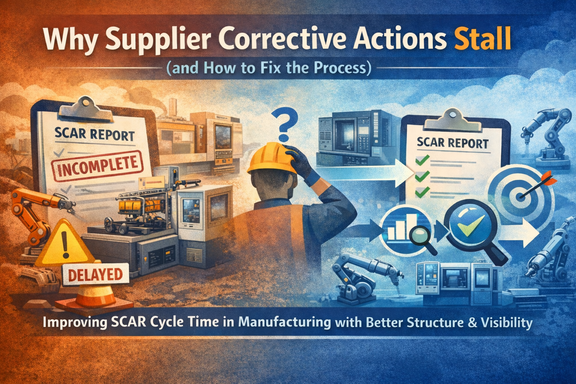
Most supplier quality teams don’t struggle with identifying issues. They struggle with getting them resolved.
Corrective actions—whether you call them SCARs, 8Ds, or CAPAs—are meant to bring structure and discipline to problem-solving. In reality, they often drag on for weeks or months, consuming time across SQEs, suppliers, and internal stakeholders.
The root problem usually isn’t technical capability. It’s process friction.
If you look closely at delayed corrective actions, the same breakdowns show up again and again. And they’re fixable.
Where SCAR processes actually break down
On paper, most organizations have a defined corrective action process. There’s a template, a set of steps, and an expectation for supplier response.
But in practice, execution happens in a much less controlled environment.
1. Requests start with unclear expectations
A SCAR is issued, often via email, with a template attached. But expectations are rarely explicit:
- What level of root cause detail is required?
- What constitutes an acceptable containment action?
- What does “complete” actually mean?
Suppliers respond based on their interpretation, which often doesn’t match the SQE’s expectations. That mismatch creates immediate rework.
2. Status tracking lives in too many places
Some teams track SCARs in Excel. Others rely on inbox folders or internal quality systems that suppliers can’t access.
The result is fragmented visibility:
- SQEs maintain their own trackers
- Managers ask for updates separately
- Suppliers don’t have a clear view of what’s open vs. overdue
Without a shared system of record, status becomes subjective and hard to trust.
3. Version control becomes a problem
Corrective actions involve iteration. That’s expected.
What’s not expected—but very common—is losing track of which version is current:
- “Final_v3.xlsx”
- “Updated_8D_latest_revised.xlsx”
- Multiple attachments across long email threads
This slows down review cycles and introduces confusion about what has actually been approved.
4. Accountability is unclear
A SCAR might have an internal owner, but supplier-side ownership is often vague.
Who is responsible for driving the response?
- Quality engineer?
- Account manager?
- Plant contact?
When ownership isn’t clearly defined on both sides, follow-up becomes reactive instead of structured.
5. Deadlines are flexible (by default)
Many corrective actions start with a nominal due date, but it quickly becomes negotiable:
- Suppliers request extensions
- Internal teams delay reviews
- Partial responses reset timelines
Without clearly defined and consistently enforced timelines, cycle time expands without much resistance.
What actually improves SCAR cycle time
Most teams try to fix slow corrective actions by escalating more aggressively.
That works occasionally, but it doesn’t scale. And it doesn’t fix the underlying issues.
The teams that consistently improve SCAR performance take a different approach: they reduce friction in the process itself.
Clear ownership on both sides
Every corrective action should have:
- A named internal owner (typically the SQE)
- A named supplier owner (specific person, not just a company)
This sounds basic, but it changes behavior. When ownership is explicit, follow-up becomes structured instead of ad hoc.
It also makes escalation more targeted when needed.
Standardized templates with clear expectations
Templates are only useful if they guide behavior.
Strong teams go beyond providing an 8D format. They define what “good” looks like:
- Examples of acceptable root cause analysis
- Clear criteria for containment vs. corrective vs. preventive actions
- Required level of detail for each section
This reduces back-and-forth and helps suppliers get closer to acceptable responses on the first submission.
Central visibility for all open actions
One of the highest-leverage improvements is moving away from scattered tracking.
Instead, teams benefit from a shared view where:
- All open SCARs are visible in one place
- Status is consistently defined
- Both internal teams and suppliers see the same information
This eliminates the need for manual status updates and reduces time spent reconciling different versions of the truth.
Defined and enforced timelines
Cycle time improves when timelines are:
- Agreed upfront
- Clearly visible
- Consistently enforced
This includes:
- Initial response deadlines
- Interim milestones (e.g., containment, root cause)
- Final closure expectations
The goal isn’t rigidity—it’s predictability. Suppliers perform better when expectations are clear and consistent.
Structured communication instead of email threads
Email is flexible, but it’s not structured.
When corrective action communication happens inside long threads:
- Context gets lost
- Decisions are buried
- New stakeholders struggle to catch up
A more structured approach—where feedback, revisions, and approvals are tied directly to the SCAR—keeps everything aligned and easier to manage.
A simple example: how delays compound
Consider a common scenario.
A supplier submits an 8D late. The SQE follows up via email. The supplier replies with partial answers.
A revised version comes in a few days later. It’s attached to a different email thread. Someone else from the supplier joins the conversation.
Internally, the SQE updates an Excel tracker, but the status doesn’t reflect the latest version. A manager asks for an update, which requires digging through emails to confirm what’s actually been received.
Now multiply that across 15–20 active suppliers.
At that scale, even small inefficiencies create significant delays. Not because people aren’t working—but because the system they’re working in isn’t supporting them.
The shift: from chasing to structuring
The most effective supplier quality teams don’t rely on chasing suppliers harder.
They design processes that make it easier for suppliers to respond correctly and on time.
That shift includes:
- Moving from email-based workflows to structured collaboration
- Making expectations explicit instead of implied
- Creating shared visibility instead of fragmented tracking
- Defining ownership and timelines upfront
When those elements are in place, corrective actions move faster with less effort.
And importantly, the quality of responses improves—not just the speed.
Why this matters beyond cycle time
Faster SCAR closure is not just about efficiency.
It directly impacts:
- Production stability
- Customer satisfaction
- Supplier performance over time
A delayed corrective action often means the underlying issue is still at risk of recurring.
By improving how corrective actions are managed, teams aren’t just closing tasks faster—they’re reducing risk across the supply base.
Closing thought
If you’re reviewing your SCAR or CAPA process, it’s worth looking beyond individual delays and mapping where friction actually exists.
In most cases, the issue isn’t effort—it’s structure.
Fixing that structure is where the real improvement happens.
Suggested next step
If you're evaluating your current process, start by mapping one recent corrective action from start to finish:
- Where did communication break down?
- Where did time get lost?
- Where was ownership unclear?
That exercise usually makes the gaps visible—and gives you a practical starting point for improvement.