How to Automate Supplier Capacity Studies
Supplier capacity studies become easier to manage when manufacturers collect structured responses by supplier, part, site, process, and program instead of chasing spreadsheets.

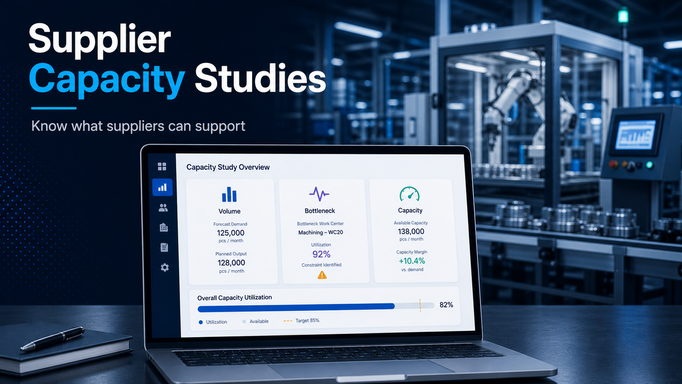
Supplier capacity studies are easy to underestimate.
The question sounds simple:
Can this supplier support the required volume?
The answer is rarely simple.
Capacity depends on the part, process, tool, production site, shift pattern, current commitments, yield, bottlenecks, customer mix, labor availability, planned downtime, and how the supplier interprets the question.
That is why supplier capacity studies become messy when they are managed through spreadsheets and email. The buyer sends a template. Suppliers fill it out differently. Some answer at the company level. Some answer by site. Some answer by machine. Some use assumptions that are not visible. Internal teams then spend days normalizing the responses before they can see the actual risk.
For manufacturers, capacity studies work better when they are treated as structured supplier data collection workflows.
Define the decision the study needs to support
Before asking suppliers for capacity data, be clear about the decision you need to make.
Different decisions require different questions.
A capacity study for a new program launch is not the same as a study for a demand increase. A study for a single-source risk review is not the same as a study for a sourcing event. A study for a bottleneck process is not the same as a broad supplier capability survey.
Start by defining the purpose:
- validating launch readiness
- checking ability to support a volume increase
- reviewing risk for a constrained commodity
- comparing suppliers during sourcing
- confirming available capacity after a customer forecast change
- identifying where additional tooling or shifts may be needed
The clearer the decision, the cleaner the data request.
Collect capacity at the right level of detail
Capacity data is only useful if it is collected at the level where constraints actually exist.
For many manufacturers, that means collecting information by:
- supplier
- production site
- part number or part family
- process step
- tooling or equipment
- customer program
- time period
If you only ask for total supplier capacity, you may miss the bottleneck. A supplier may have plenty of general capacity but limited capacity on a specific press, mold, coating line, testing operation, or assembly cell.
If you ask for too much detail, suppliers may struggle to respond and the internal team may never use half the fields.
The goal is practical precision: enough structure to make the answer useful, but not so much that the process collapses under its own weight.
Standardize the assumptions
Capacity answers are only comparable when the assumptions are visible.
Two suppliers may both say they can support 100,000 units per month, but one may assume five shifts and overtime while another assumes current staffing. One may include planned downtime. Another may not. One may assume current scrap rates. Another may report theoretical maximum capacity.
A good capacity study should ask for the assumptions behind the answer:
- number of shifts
- available hours
- cycle time
- uptime or OEE assumption
- scrap or yield assumption
- current committed volume
- available additional volume
- lead time to add capacity
- major constraints
- confidence level
This makes the response easier to compare and easier to challenge.
It also helps the internal team separate actual available capacity from optimistic supplier answers.
Make the supplier response structured
The biggest weakness of spreadsheet-based capacity studies is variation.
Suppliers modify templates, add columns, skip required fields, merge cells, change units, and attach supporting documents in separate emails. Then the internal team becomes the data cleanup team.
A structured response workflow reduces that problem.
Instead of asking suppliers to interpret a spreadsheet, define the fields they need to complete. Use required fields where needed. Use dropdowns for standard answers. Make units clear. Allow comments and attachments, but keep the core data structured.
That makes the output easier to analyze by part, supplier, process, region, or program.
It also helps suppliers understand exactly what is being asked.
Track gaps and follow-up actions
A capacity study should not end when the responses arrive.
The real value comes from identifying gaps and assigning follow-up.
Common follow-up actions include:
- ask supplier to clarify assumptions
- request a capacity improvement plan
- validate tooling constraints
- involve engineering or supplier quality
- qualify an alternate supplier
- escalate risk to program management
- update launch readiness status
If those actions are managed separately from the study, the process loses traceability. Six weeks later, someone may know there was a capacity risk, but not who owned the next step or whether it was closed.
Capacity studies should create a clear path from supplier response to internal decision.
Where Supplios can help
Supplios can help manufacturers run supplier capacity studies through structured supplier workflows instead of spreadsheet chases.
Depending on the use case, teams can use Sourcing and Procurement workflows for RFIs and supplier surveys, supplier management records for supplier and capability context, and custom workflows for capacity reporting by part, supplier, site, process, or program.
Supplios can also help teams assign supplier tasks, collect structured responses, track non-responses, keep discussion history, and connect capacity findings to broader supplier records.
Capacity studies are not just data collection.
They are risk management.
If your team needs to understand whether suppliers can support a launch, demand change, or sourcing decision, the workflow should make the answer easier to collect, compare, and act on. Supplios gives manufacturers one option for turning capacity studies from a spreadsheet exercise into a repeatable supplier process.