How to Collect Multi-Tier Supplier Data When an OEM Customer Sends a Survey
Tier 1 manufacturers can handle OEM supplier surveys more effectively by turning customer requests into structured supplier outreach, response tracking, and evidence collection workflows.

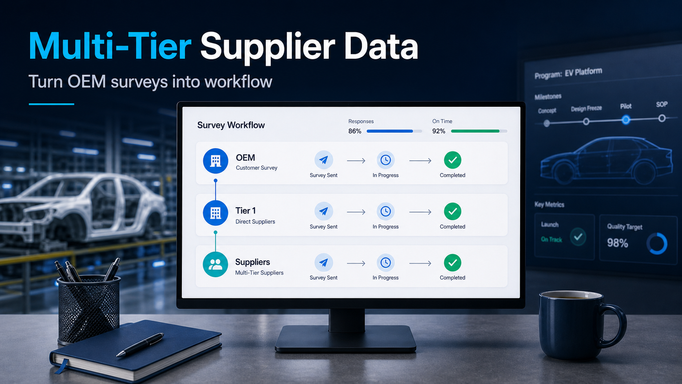
Automotive OEMs often ask suppliers for information that does not stop at Tier 1.
A customer may ask about material availability, sustainability, origin data, compliance status, cybersecurity, forced labor risk, conflict minerals, PFAS, carbon reporting, capacity exposure, or operational disruption.
For a Tier 1 supplier, the hard part is not receiving the survey.
The hard part is turning it into a controlled process across your own suppliers, and sometimes their suppliers too.
If the request is managed through email, the process gets messy fast. The OEM template gets forwarded. Suppliers ask what applies to them. Some answer at the company level. Some answer by part. Some send attachments. Some respond late. Some do not respond at all. Internal teams then spend days consolidating partial answers into something the customer can use.
Multi-tier supplier data collection needs more structure than that.
Translate the OEM request into an internal workflow
The first step is understanding what the customer is really asking for.
An OEM survey may include questions that apply to all suppliers, only certain commodities, only specific parts, only certain regions, or only suppliers with known risk exposure. Before launching outreach, the Tier 1 team should translate the customer request into an internal workflow.
That means answering:
- which suppliers are in scope
- which parts, materials, or programs are affected
- whether sub-tier data is required
- what evidence or attachments are needed
- who owns the response internally
- when supplier responses are due
- how the final customer response will be consolidated
This step matters because simply forwarding the OEM request usually creates confusion.
Suppliers need clear instructions from you, not just a customer template with no operating context.
Segment suppliers before sending the survey
Not every supplier needs the same survey.
A supplier providing a critical direct material may need to answer detailed part-level questions. A supplier outside the affected commodity may only need to confirm non-applicability. A supplier with sub-tier exposure may need to flow down the request. A low-risk supplier may not need to be contacted at all.
Supplier segmentation helps avoid over-surveying and under-surveying.
Useful segmentation can include:
- customer program
- part family
- commodity
- production site
- region
- direct material status
- supplier criticality
- known risk indicators
When segmentation is weak, teams tend to overcompensate with broad outreach. That creates more work for suppliers and more noise for internal teams.
The better approach is targeted outreach with clear rationale.
Give suppliers clear flow-down instructions
Multi-tier requests create a specific problem: your supplier may not have the answer directly.
They may need to ask their own suppliers.
That means your request should be explicit about whether sub-tier data is required and how far the supplier needs to go. If the OEM expects multiple tiers of visibility, say that clearly. If the supplier only needs to answer based on their direct operation, say that too.
Useful instructions include:
- what suppliers should ask their own suppliers
- whether attachments are required
- whether estimates are acceptable
- how to report unknowns
- how to handle non-applicable cases
- what deadline applies to sub-tier collection
Without this clarity, suppliers will make their own assumptions. Those assumptions will not always match what the OEM expects.
Track responses and non-responses in real time
For customer-driven surveys, timing matters.
The OEM has a deadline. The Tier 1 needs time to collect supplier responses, review them, follow up on gaps, consolidate answers, and respond to the customer.
If supplier responses are tracked manually, the internal team loses time on status updates:
- Who has answered?
- Who is overdue?
- Which suppliers need clarification?
- Which responses are incomplete?
- Which responses include sub-tier data?
- Which gaps need to be disclosed?
Those questions should not require inbox archaeology.
A structured workflow should show status by supplier and give owners a clear path for follow-up.
Review, consolidate, and preserve the record
Collecting responses is only part of the job.
The Tier 1 team still needs to review them, consolidate the customer response, and preserve the evidence behind what was submitted.
That review may involve procurement, supplier quality, compliance, engineering, sustainability, legal, or program management depending on the request.
The workflow should make it easy to:
- identify incomplete or inconsistent supplier answers
- ask for clarification
- approve usable responses
- summarize gaps
- export or consolidate data
- retain evidence for future customer questions
This is especially important when the same customer asks similar questions later. If the previous campaign is only stored in email, the team has to rebuild too much from scratch.
Where Supplios can help
Supplios can help Tier 1 manufacturers manage customer-driven supplier surveys as structured supplier outreach workflows.
Teams can use Supplios to identify affected suppliers, launch targeted surveys or RFIs, assign supplier tasks, collect structured responses, track non-responses, and keep evidence connected to the supplier record. The supplier portal gives suppliers one place to respond, while supplier management and sourcing and procurement workflows can help organize supplier context and structured response collection.
Supplios is not a substitute for your customer's requirements or your team's compliance judgment.
It is a way to make the collection process easier to control.
When an OEM survey arrives, the goal is not just to send more emails faster. The goal is to know who needs to respond, what they need to provide, which answers are complete, and what can be confidently reported back to the customer. A structured supplier workflow makes that possible.