How to Collect Supplier Insurance, Environmental, and Safety Certificates
Supplier insurance, environmental, and safety certificates are easier to manage when requirements, uploads, reviews, and renewals are handled in one compliance workflow.

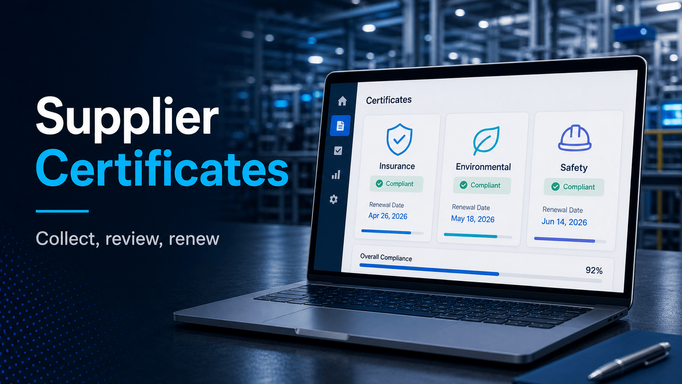
Supplier compliance is not only ISO 9001 and IATF 16949.
Manufacturers often need to collect many other documents from suppliers:
- insurance certificates
- ISO 14001 certificates
- safety certifications
- REACH declarations
- RoHS declarations
- environmental permits
- supplier code of conduct acknowledgements
- sustainability forms
- cybersecurity attestations
- customer-specific compliance records
These documents may be owned by different internal teams. Procurement may care about insurance. Compliance may care about environmental declarations. Supplier quality may care about certifications. Legal may care about acknowledgements. Operations may care about safety records for suppliers working on site.
That cross-functional ownership is exactly why the process gets messy.
If every document type is handled through a different spreadsheet, shared folder, or email thread, no one has a reliable view of supplier compliance status.
List the document types you need to manage
Start by defining the document types that matter to your business.
This sounds simple, but many manufacturers have requirements scattered across procedures, customer requirements, onboarding checklists, audit findings, contract language, and individual team preferences.
Create a practical document inventory:
- certificate of insurance
- ISO 14001
- ISO 45001
- safety training evidence
- REACH declaration
- RoHS declaration
- environmental permit
- hazardous material documentation
- supplier code of conduct acknowledgement
- sustainability questionnaire
- cybersecurity questionnaire
For each document type, define what makes the document acceptable.
Does it need an expiration date? Does it need to apply to a specific supplier site? Does it need to be reviewed by legal, compliance, EHS, procurement, or quality? Does a signed acknowledgement count, or is supporting evidence required?
If the internal team cannot answer those questions, suppliers will not be able to either.
Decide which suppliers need which documents
Not every supplier needs every document.
An on-site services supplier may need insurance and safety records. A direct material supplier may need environmental declarations. A logistics provider may need a different set of certificates than a tooling supplier. A supplier tied to a specific customer program may need customer-specific documentation.
Requirement rules can be based on:
- supplier type
- commodity
- region
- site location
- direct vs. indirect material
- supplier risk level
- customer program
- on-site work
- regulated material exposure
This is where manual tracking gets weak.
If document requirements live in someone's spreadsheet, the rules are easy to miss. If supplier categories change, the document requirements may not update. If a supplier becomes active for a new commodity, the compliance process may not follow.
A strong workflow connects supplier requirements to supplier data.
Give suppliers clear upload tasks
Suppliers should not have to guess where to send documents.
For each required document, the supplier should see:
- what document is required
- which supplier entity or site it applies to
- what format is acceptable
- when it is due
- whether it needs renewal
- who will review it
- what happens if it is rejected
This is especially important for documents like insurance certificates, environmental certificates, and safety records where the right file may depend on location, coverage period, or issuing authority.
Direct uploads reduce the need for internal teams to download attachments, rename files, upload them to folders, and update trackers manually.
Track review status separately from upload status
A supplier document can be uploaded and still not be accepted.
The insurance certificate may have insufficient coverage. The environmental certificate may be for the wrong location. The safety record may be expired. The REACH declaration may not cover the relevant materials. The document may be missing a signature or date.
That means the workflow needs review status, not just upload status.
Useful statuses include:
- required
- requested
- submitted
- under review
- approved
- rejected
- expiring soon
- expired
- not applicable
This helps the team understand what is actually complete.
It also gives suppliers clearer feedback when something needs correction.
Manage renewals before documents expire
Many supplier documents have validity periods.
The process should not wait until expiration to create work.
For insurance, environmental, and safety certificates, expiration tracking should trigger reminders before the document becomes a gap. Critical suppliers may need earlier reminders and escalation than low-risk suppliers. Some documents may need internal review before renewal is accepted.
A useful renewal workflow should include:
- expiration date
- reminder timing
- supplier task
- internal owner
- review step
- overdue status
- escalation path
This turns certificate renewal into a managed process instead of a calendar reminder.
Where Supplios can help
Supplios can help manufacturers manage insurance, environmental, safety, and other supplier compliance documents through the Supplier Compliance module.
Teams can define document types, assign requirements to suppliers, allow direct supplier uploads, track expiration dates, route documents for approval, send reminders, and view compliance status across the supplier base. Supplier document records can also connect back to broader supplier management context such as categories, locations, tags, and internal ownership.
That gives teams one place to see what is missing, what is expiring, what needs review, and which suppliers still need follow-up.
If supplier documents are spread across inboxes, folders, and spreadsheets, the problem is not just storage. It is workflow. The right process should make supplier requirements visible, supplier submissions easy, and compliance gaps hard to miss.