Why Manufacturers Should Manage Supplier PPAP in a Dedicated Platform
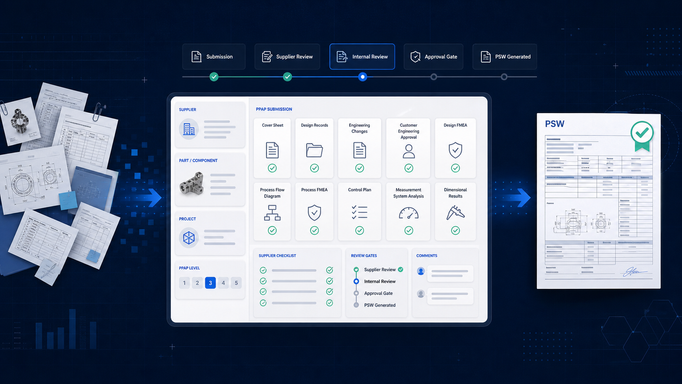
A supplier operations platform helps manufacturers run PPAP faster and with better control by organizing documents, capturing discussion history, and automating workflows like PSW generation.

Most supplier PPAP problems are not technical.
They are coordination problems.
The drawing is in one place. The capability study is in another. Someone shared the latest control plan by email, but the supplier uploaded a newer version to a shared drive. The PSW gets approved, but three months later no one can find the full review trail that explains why it was approved with specific conditions.
That is how PPAP becomes slow, messy, and risky.
If you are still managing PPAP through inboxes, spreadsheets, and disconnected folders, you are making a hard process even harder.
A supplier operations platform like Supplios changes that by giving you one workflow where suppliers and internal teams can collaborate on PPAP from first submission to final sign-off.
1) Suppliers can upload PPAP documents directly in the workflow
In many companies, suppliers still send PPAP files through email or file-transfer links.
That immediately creates version-control issues.
Different people download different files. Some files are renamed manually. A buyer, SQE, and engineer may each work from slightly different versions without realizing it.
When suppliers upload directly into a structured PPAP workflow, those issues shrink fast:
- suppliers upload to the exact PPAP package, not a generic inbox
- internal teams review the same source files
- required document lists are visible up front
- missing items are clear immediately, not discovered late
This reduces back-and-forth and helps suppliers understand exactly what is expected for each submission.
2) PPAP documentation is naturally organized by part, supplier, and project
A big PPAP pain point is retrieval.
You may get approval done, but six or twelve months later, finding the full package can still be painful. Teams waste time asking:
- Which folder has the final dimensional report?
- Was this approval for the supplier location in Plant A or Plant B?
- Was this tied to a new launch, engineering change, or transfer?
A dedicated platform solves this by organizing PPAP records around the real operating context:
- supplier
- part or part family
- plant/program/project
- submission cycle and status
That means your PPAP data is usable after approval, not just during approval.
3) You capture the full discussion and decision history, not just a final status
A final "approved" status is not enough context.
What matters during audits, escalations, and new program launches is the history:
- what concerns were raised
- what evidence the supplier added
- who requested updates
- which conditions were attached to approval
- when decisions changed and why
Email threads and meeting notes rarely preserve this cleanly.
A platform-based PPAP process creates a time-stamped collaboration trail tied directly to the submission. This gives supplier quality, engineering, and management teams much better traceability and confidence.
4) PSW generation becomes automatic instead of manual paperwork
In spreadsheet-and-email PPAP processes, the PSW is often built manually at the end.
That creates avoidable risk:
- missing fields
- inconsistent formatting
- data copied from outdated files
- extra admin work for SQEs
With a structured PPAP workflow, much of the required information is already captured during the review process. A platform can automatically generate the PSW from that submission data, which helps teams:
- reduce administrative effort
- improve consistency across suppliers and plants
- shorten cycle time from "technically ready" to "formally approved"
It is a small operational change with a large cumulative impact.
5) Standardized PPAP workflows are easier to scale across plants and programs
As manufacturers grow, PPAP variation grows with them.
Different plants use different checklists. Different teams use different naming conventions. Escalations are handled differently depending on who is involved.
Some variation is normal, but too much variation creates confusion for both internal teams and suppliers.
A supplier operations platform helps you standardize the core PPAP flow while still allowing controlled flexibility where needed. You can define required steps, roles, document expectations, and approval gates in one repeatable model.
That improves speed for experienced teams and clarity for new team members.
Better PPAP execution is really about better supplier collaboration
Manufacturers do not struggle with PPAP because they lack expertise.
They struggle because the process is often fragmented across tools that were never designed to support cross-functional supplier collaboration.
A platform like Supplios gives you a practical way to run PPAP with more control, faster turnaround, and better long-term visibility.
If your team wants to improve PPAP performance without adding more manual follow-up, explore how Supplios supports supplier quality workflows, supplier document management, and cross-functional supplier operations in a platform demo.