How to Quickly Survey Suppliers During a Supply Chain Disruption
When disruptions hit, manufacturers need a fast way to survey suppliers, track responses, and identify risk without relying on scattered email threads.

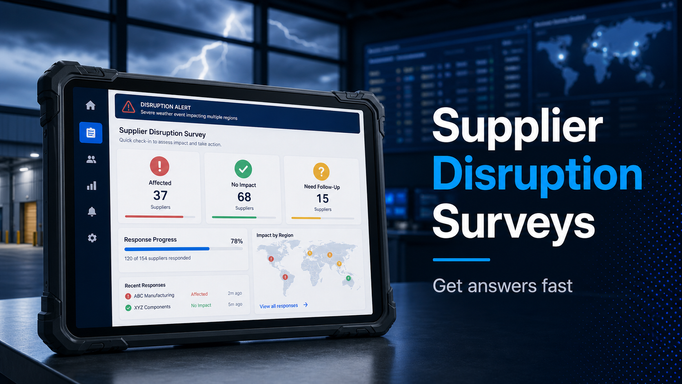
When a supply chain disruption hits, supplier visibility matters fast.
A storm affects a region. A port backs up. A material shortage spreads. A labor disruption shuts down a logistics route. A geopolitical event creates uncertainty. A fire, flood, earthquake, cyberattack, or utility outage affects a supplier site.
The first question is usually simple:
Which suppliers are impacted?
The second question is harder:
What does that mean for our parts, plants, customers, and production schedule?
Many manufacturers still answer those questions by sending urgent emails and hoping suppliers reply quickly. That can work for a small supplier base. It breaks down when the affected suppliers span regions, commodities, plants, or customer programs.
During a disruption, supplier surveys need to be fast, targeted, structured, and visible.
Start with the affected supplier population
The first mistake is surveying too broadly or too narrowly.
If you send the same urgent request to every supplier, you create noise. Low-risk suppliers respond with irrelevant information, while critical suppliers may get buried in the same follow-up process.
If you rely only on memory, you may miss suppliers with sites, sub-suppliers, warehouses, or logistics routes in the affected area.
Start by filtering suppliers based on the disruption:
- region or country
- production site
- shipping lane
- commodity
- part family
- customer program
- criticality
- supplier risk tier
The goal is to build the right outreach list quickly and explain why each supplier is included.
That is much easier when supplier data is already structured before the disruption happens.
Ask questions that produce usable answers
Disruption surveys should be short enough for suppliers to answer quickly, but structured enough for internal teams to act on.
Good questions usually cover:
- whether the supplier is directly impacted
- which site or operation is affected
- which parts or materials may be affected
- current inventory on hand
- open shipments or expected delays
- estimated recovery timing
- alternate production or shipping options
- major constraints
- escalation contact
- confidence level in the response
Avoid asking for long narrative updates when you need fast triage.
Use structured fields where possible. A yes/no impact question, affected site field, expected delay range, and comments box will be easier to analyze than fifty free-form email replies.
Set a clear deadline and escalation path
In a disruption, non-response is information.
If a critical supplier does not respond, the team needs to know that quickly. Waiting for someone to manually check an inbox creates risk.
Every disruption survey should include:
- a response deadline
- a clear supplier owner
- automated reminders where possible
- escalation rules for critical suppliers
- internal visibility into non-responses
This is where the process becomes more than a survey. It becomes an operating workflow.
The supply chain team should not need to ask, "Who has not answered yet?" That answer should be visible.
Connect responses to parts and plants
A supplier saying "we are impacted" is only the start.
The internal team needs to understand what that means.
If the supplier supports one low-volume service part, the response may not require immediate escalation. If the supplier supports a production-critical part for three plants and has no alternate line, the response needs attention immediately.
Survey data becomes more useful when it connects to:
- supplied parts
- plant or site served
- customer program
- open orders
- supplier criticality
- existing quality or delivery risk
- sourcing status
Even if every integration is not available, the workflow should make it easy to attach supplier impact information to the right supplier record and follow-up actions.
Summarize risk while the situation is still moving
Disruption response is not a one-time report.
Supplier answers may change as the event develops. A supplier may initially report no impact, then discover a sub-tier issue. Another may recover faster than expected. A third may need a temporary logistics workaround.
The team needs a live view:
- suppliers impacted
- suppliers not impacted
- suppliers still unknown
- critical parts at risk
- estimated recovery timing
- open follow-up actions
- escalations
This allows purchasing, supply chain, operations, and leadership to make decisions while there is still time to act.
Where Supplios can help
Supplios can help manufacturers launch targeted supplier surveys during disruptions and track the response process in one place.
Teams can use Supplios to identify relevant suppliers, send structured requests, assign supplier tasks, collect responses, track non-responses, and keep internal teams aligned through a shared supplier workflow. The supplier portal gives suppliers one place to respond, while supplier management context helps teams understand which suppliers, sites, categories, and capabilities are involved.
For manufacturers using Supplios across supplier operations, disruption survey results can also become part of the broader supplier record instead of disappearing into an old email thread.
Disruptions will not wait for clean data.
That is why the response process needs to be ready before the next event. A structured supplier survey workflow gives manufacturers a faster way to understand impact, focus follow-up, and protect production when the supply base is under pressure.