How to Run a Supplier Readiness Check Before a New Program Launch
A supplier readiness check helps manufacturers confirm capacity, tooling, PPAP, packaging, logistics, contacts, and open risks before launch pressure hits.

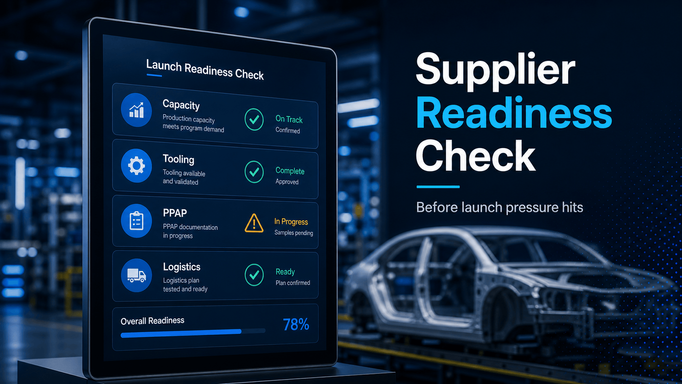
Supplier readiness problems are expensive because they show up late.
A supplier says capacity is fine, but the bottleneck process is not ready. Tooling is delayed. Packaging is unresolved. PPAP is still open. The logistics contact has changed. A special process supplier is behind. The supplier's launch team has a different assumption than your program team.
By the time the issue becomes visible, everyone is already under launch pressure.
That is why manufacturers need a structured supplier readiness check before a new program launch.
The goal is not to create another status meeting.
The goal is to confirm, with evidence, whether each supplier is ready to support the program.
Define what "ready" means
Supplier readiness should not be a vague confidence score.
It should be tied to the specific conditions required for launch.
For most manufacturing programs, readiness may include:
- capacity confirmed
- tooling complete
- PPAP submitted or approved
- APQP tasks on track
- packaging defined
- logistics plan confirmed
- quality contacts assigned
- escalation contacts confirmed
- inspection plan ready
- supplier site prepared
- open risks documented
- recovery plans defined
The exact checklist depends on the product, customer, industry, and launch process.
Automotive teams may tie readiness to APQP, PPAP, run-at-rate, capacity studies, customer-specific requirements, and supplier launch support. Industrial and equipment manufacturers may use different milestones, but the core problem is the same: the supplier side of the launch needs structured follow-up.
Segment suppliers by launch risk
Not every supplier needs the same readiness review.
A new supplier making a production-critical direct material part should not be treated like a stable supplier providing a low-risk purchased item. A supplier with new tooling, new process steps, or a history of launch issues needs more scrutiny.
Segment suppliers by risk factors such as:
- new supplier vs. existing supplier
- new part vs. carryover part
- customer-critical component
- single-source status
- past quality or delivery issues
- capacity constraints
- special process requirements
- tooling complexity
- supplier site or region risk
This helps the team focus the readiness check where it matters most.
It also keeps the process practical. If every supplier receives the same heavy checklist, the team may spend too much time reviewing low-risk items and too little time on real launch risk.
Collect structured supplier evidence
A launch readiness check should not rely only on verbal updates.
Suppliers should provide structured responses and supporting evidence where needed.
Examples include:
- capacity confirmation
- tooling status
- production trial results
- PPAP submission status
- packaging approval status
- logistics route confirmation
- staffing or shift plan
- inspection readiness
- key contact list
- open issue list
- recovery or mitigation plan
The evidence does not need to be excessive. It needs to be useful.
The point is to avoid discovering late that two teams had different definitions of "on track."
Make internal ownership clear
Supplier readiness is cross-functional.
Supplier quality may own PPAP, APQP, and quality evidence. Purchasing may own commercial status and supplier escalation. Engineering may own technical questions. Logistics may own packaging and shipment readiness. Program management may own launch timing and risk reporting.
If ownership is not clear, readiness checks become meeting notes.
A structured workflow should assign actions to the right internal owners:
- SQE reviews PPAP and quality readiness
- buyer follows up on supplier commitment
- engineering reviews technical gaps
- logistics confirms shipping and packaging
- program manager reviews launch risk
Each open issue should have an owner, due date, and status.
That is how a readiness check becomes a launch control process instead of a discussion.
Track open risks until closure
The readiness check should produce a clear view of supplier launch risk.
Common risk categories include:
- capacity gap
- tooling delay
- PPAP delay
- packaging issue
- logistics constraint
- documentation gap
- contact or escalation gap
- quality concern
- supplier resource constraint
Each risk should be tracked until it is closed, accepted, or escalated.
The most important part is making the risk visible while there is still time to act. A supplier issue discovered before launch may be manageable. The same issue discovered after production starts can become a customer problem.
Where Supplios can help
Supplios can help manufacturers run supplier readiness checks through structured supplier workflows.
Depending on the process, teams can use NPI and PPAP workflows, Sourcing and Procurement RFIs or surveys, supplier tasks, document uploads, internal approvals, and custom workflow steps to collect readiness evidence and track open risks. Supplios can also connect readiness work to supplier records, part context, PPAP status, and other supplier quality activity.
This gives supplier quality, purchasing, engineering, logistics, and program teams one shared view of supplier readiness.
Launches do not fail because teams lack meetings.
They fail because risk is discovered too late, ownership is unclear, or supplier evidence is scattered. A structured supplier readiness check gives manufacturers a better way to know which suppliers are ready, which are not, and what needs to happen next.