Why Supplier Segmentation Is the Foundation of Better Supplier Management
Supplier segmentation helps manufacturers manage complex supplier bases with clearer priorities, more consistent workflows, and better visibility across purchasing, supplier quality, and supply chain teams.

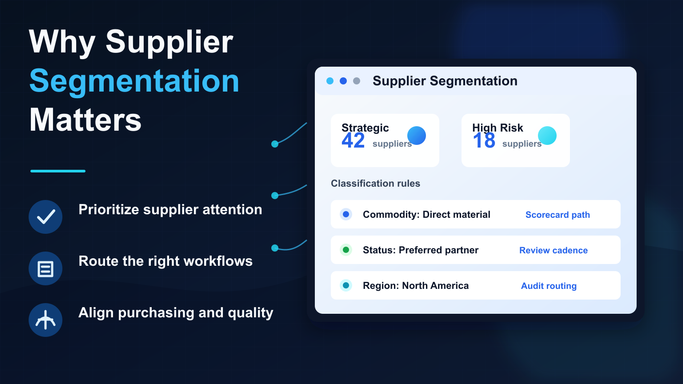
Most manufacturers do some form of supplier segmentation already.
They may not call it that.
A buyer knows which suppliers are strategic. A supplier quality engineer knows which suppliers create the most quality issues. A plant team knows which suppliers can stop production if they miss a shipment. A category manager knows which suppliers are approved for a commodity. Finance may know which suppliers represent the most spend.
That knowledge is useful.
But in many companies, it is not structured.
It lives in spreadsheets, ERP fields, email threads, plant-specific trackers, meeting notes, and individual memory. One team may describe a supplier as strategic. Another team may think of the same supplier as high-risk. A third team may not know either classification exists.
That creates a real supplier management problem.
As the supply base grows, informal knowledge does not scale. More suppliers, more plants, more commodities, more quality requirements, more compliance documents, and more supplier-facing workflows all make it harder to decide who needs attention, what process should apply, and where risk is building.
This is why supplier segmentation matters.
Supplier segmentation is not just a reporting exercise. It is the foundation for deciding how different suppliers should be managed.
What supplier segmentation actually means
Supplier segmentation means grouping suppliers by criteria that matter to how your business manages them.
That can include obvious categories, such as:
- commodity or product category
- direct material vs. indirect material
- geographic region
- production site or plant served
- supplier location
- annual spend
- strategic importance
- preferred or partner status
- approved, conditional, probationary, inactive, or blocked status
It can also include more operational categories, such as:
- onboarding status
- compliance status
- quality performance
- delivery performance
- responsiveness
- audit history
- open claims or corrective actions
- launch or program involvement
- supplier risk level
- business continuity importance
The goal is not to create a complicated taxonomy for its own sake.
The goal is to make supplier data useful.
If a supplier is production-critical, the organization should know that. If a supplier is approved only for a specific commodity, the sourcing process should reflect that. If a supplier is still missing onboarding documents, teams should not treat that supplier the same as a fully approved supplier. If a supplier is a preferred partner in one region but not another, that distinction should be visible.
Good segmentation turns scattered supplier knowledge into an operating model.
The problem with informal segmentation
Informal segmentation works when the supplier base is small and the same few people are involved in every decision.
It breaks down when the organization gets larger.
This is especially common in automotive and industrial manufacturing, where supplier relationships are cross-functional by nature. Purchasing may own the commercial relationship. Supplier quality may own defects, corrective actions, audits, PPAP, and supplier development. Supply chain may own delivery risk and continuity. Engineering may own technical readiness, drawings, specifications, and launch requirements. Operations may feel the impact first when a supplier misses.
Each group may have a different view of the supplier.
That is not wrong. It is reality.
The problem is when those views are not connected.
A supplier may be listed as approved in an ERP system, but still missing critical documentation. Another supplier may be commercially preferred, but have declining quality performance. A supplier may be used by several plants, but only one plant has escalated repeated delivery problems. A new supplier may be onboarded for one product family, then quietly reused for another without the right approval path.
In those situations, supplier segmentation exists in fragments.
One team knows part of the truth. Another team knows another part. Leadership sees a report that may be technically correct, but incomplete.
That is how manufacturers end up with inconsistent supplier decisions.
Treating every supplier the same wastes attention
Not every supplier should be managed the same way.
That may sound obvious, but many supplier management processes are built as if every supplier deserves the same workflow, the same documentation requirements, the same review rhythm, and the same level of follow-up.
That creates two problems.
First, important suppliers do not always get enough attention.
A supplier tied to production-critical direct material, a launch program, a safety-related component, or a constrained commodity may need more frequent reviews, tighter scorecard tracking, deeper audits, and clearer escalation paths.
Second, low-risk suppliers get pulled into processes that are heavier than necessary.
If every supplier has to go through the same level of review, the process becomes slow. Internal teams spend time chasing information that may not drive a real decision. Suppliers get frustrated by unnecessary requests. The organization creates work without improving control.
Segmentation helps teams match effort to importance.
A strategic direct-material supplier should not be managed like a one-time indirect supplier. A high-risk quality supplier should not be managed like a stable partner with years of strong performance. A supplier in early onboarding should not be treated like one that has completed all required approvals.
When segmentation is clear, teams can focus more attention where it matters.
Segmentation makes supplier workflows more consistent
The strongest supplier segmentation models do more than describe suppliers.
They drive workflow.
For example, segmentation can help determine:
- which onboarding path a supplier follows
- which documents are required
- which internal approvals are needed
- which suppliers can participate in a sourcing event
- which suppliers receive scorecards
- which scorecard format applies
- which suppliers need annual audits
- which suppliers require compliance renewals
- which suppliers trigger escalation when performance drops
- which suppliers should be included in supplier development plans
This is where segmentation becomes operational.
Instead of relying on someone to remember the right process, the supplier profile helps determine the process.
If a supplier is tagged as a direct-material supplier in a critical commodity, that can drive a more rigorous onboarding workflow. If a supplier is approved for electronics but not stamped metal parts, that should affect sourcing eligibility. If a supplier is marked as high-risk after repeated quality claims, that should affect audit frequency, scorecard review, or improvement follow-up.
Without segmentation, teams make these decisions manually.
Manual decision-making is flexible, but it is also inconsistent. Two buyers may use different judgment. Two plants may apply different standards. Supplier quality may not know the latest commercial status. Purchasing may not know the latest quality status.
Segmentation gives the organization a shared structure.
It does not remove judgment.
It gives judgment a better starting point.
Segmentation improves cross-functional visibility
Supplier management is not owned by one team.
That is why segmentation needs to be visible across functions.
Purchasing may care about category, spend, preferred status, and commercial leverage. Supplier quality may care about audit history, PPM, 8D responsiveness, PPAP readiness, and corrective action follow-up. Supply chain may care about delivery stability, region, capacity, and business continuity risk. Engineering may care about technical capability, product family, and launch involvement.
All of those views can be valid at the same time.
A useful supplier segmentation model should allow for that.
The goal is not to reduce every supplier to one label.
The goal is to make the important dimensions searchable, visible, and usable.
For example, a supplier could be:
- a preferred supplier for machined components
- approved for two plants
- active in one launch program
- high-spend
- currently below target on delivery
- missing one compliance renewal
- assigned to a specific lead buyer and SQE
That combination matters.
It tells the organization more than a single status field ever could.
When that information is visible, teams can have better supplier conversations. Leadership can see which suppliers need attention. Buyers can filter sourcing lists more confidently. SQEs can prioritize audits and corrective action follow-up. Supply chain leaders can identify where supplier risk is concentrated.
Segmentation turns supplier data into a management tool.
Good segmentation starts simple
One mistake companies make is trying to design the perfect supplier segmentation model before they start.
That usually does not work.
The model gets too detailed. The categories become hard to maintain. Teams argue over definitions. Fields are added because someone might want them someday. Eventually, the segmentation structure becomes another data cleanup project.
A better approach is to start with the supplier categories that drive real decisions.
Ask questions like:
- Which supplier attributes change the onboarding process?
- Which suppliers need different document requirements?
- Which suppliers should receive scorecards?
- Which suppliers need regular performance reviews?
- Which suppliers are eligible for specific sourcing events?
- Which suppliers require more frequent audits?
- Which status changes should trigger internal approval?
- Which fields do leadership teams actually use to prioritize attention?
Those questions keep the segmentation model practical.
If a field does not change a decision, workflow, report, or ownership model, it may not need to be part of the first version.
Good supplier segmentation usually grows over time.
A manufacturer may start with commodity, direct vs. indirect, region, status, preferred supplier flag, lead buyer, supplier quality owner, and onboarding status. Later, it may add risk level, scorecard tier, audit frequency, program involvement, production criticality, or custom classifications by business unit.
The important thing is that the model stays usable.
Segmentation should help teams manage suppliers.
It should not become a data exercise that everyone quietly ignores.
Supplier status should not be a dead-end field
Many companies have supplier status fields somewhere.
Approved. Preferred. Conditional. Inactive. Blocked. New. Probationary.
Those labels can be useful, but only if they mean something operationally.
If a supplier is marked conditional, what changes?
Can the supplier receive new business?
Does purchasing need approval before using them?
Does supplier quality need to complete an audit?
Does the supplier need to submit missing documents?
Does leadership need to review the status after 90 days?
If none of those things happen, the status field is mostly decorative.
The same is true for preferred supplier status. A preferred supplier label should influence sourcing behavior, supplier reviews, relationship management, and performance expectations. If it does not change anything, it is just a label.
Supplier segmentation becomes valuable when status creates action.
That may mean a workflow starts. A task is assigned. A document is requested. A scorecard frequency changes. A supplier is removed from sourcing eligibility. An audit is scheduled. A manager is notified.
The label is only the beginning.
The process behind the label is what creates control.
Segmentation depends on supplier data quality
Supplier segmentation cannot work if the underlying data is unreliable.
That is one reason spreadsheet-based segmentation often breaks down.
A spreadsheet may start clean, but supplier data changes constantly. Contacts change. Locations change. Certifications expire. Capabilities evolve. Supplier ownership changes. Plants add suppliers locally. New supplier relationships begin through urgent sourcing events. Old suppliers remain active in systems long after they should be reviewed.
If supplier segmentation is not maintained, teams stop trusting it.
Once teams stop trusting it, they go back to manual workarounds.
They ask around. They check old emails. They keep their own trackers. They use personal judgment because the official system is incomplete.
That is how segmentation loses power.
The answer is not to create more spreadsheets.
The answer is to connect segmentation to the supplier data foundation and the workflows that keep supplier data current.
When onboarding, compliance, audits, scorecards, claims, sourcing, and supplier updates all use the same supplier profile, segmentation becomes easier to maintain. Supplier changes are more visible. Teams have fewer duplicate lists. Supplier status is more likely to reflect reality.
Segmentation is not separate from supplier data management.
It is one of the main reasons supplier data management matters.
How Supplios helps make segmentation operational
Supplios helps manufacturers manage supplier segmentation as part of a broader supplier management system.
Instead of keeping supplier categories, status values, contacts, capabilities, and ownership fields scattered across spreadsheets and disconnected systems, Supplios gives teams a central supplier profile that can support tags, classifications, custom fields, supplier locations, contacts, and internal assignments.
That matters because segmentation should not sit off to the side.
It should help drive the work.
In Supplios, supplier tags and classifications can help determine which suppliers are included in workflows, which onboarding path applies, which compliance requirements matter, which scorecard applies, which suppliers should be included in sourcing events, and which internal owners are responsible for follow-up.
That connects segmentation to the actual supplier operations that purchasing, supplier quality, supply chain, and operations teams manage every day.
For example, supplier onboarding can use supplier categories to route approvals, collect the right documents, and apply the right requirements. Supplier performance can use supplier data to support scorecards, KPI reporting, and supplier improvement actions. For automotive manufacturing, this kind of structure is especially important because suppliers are tied to quality, delivery, PPAP/APQP readiness, claims, audits, launch risk, and cross-functional accountability.
The point is not to build a perfect supplier taxonomy.
The point is to make supplier management more controlled, visible, and repeatable.
If your organization is managing supplier segments through a mix of spreadsheets, ERP fields, plant knowledge, and old email threads, the segmentation probably already exists.
It just is not structured enough to drive the work.
Formalizing supplier segmentation is one of the simplest ways to make supplier management more scalable.
And when the segmentation is connected to workflows, scorecards, onboarding, audits, compliance, sourcing, and supplier data, it becomes much more than a label.
It becomes part of how the organization runs supplier operations.