How to Track Supplier Corrective Action Follow-Up After a Quality Issue
Supplier corrective action follow-up works better when containment, root cause, corrective action, evidence, approvals, and effectiveness checks stay connected.

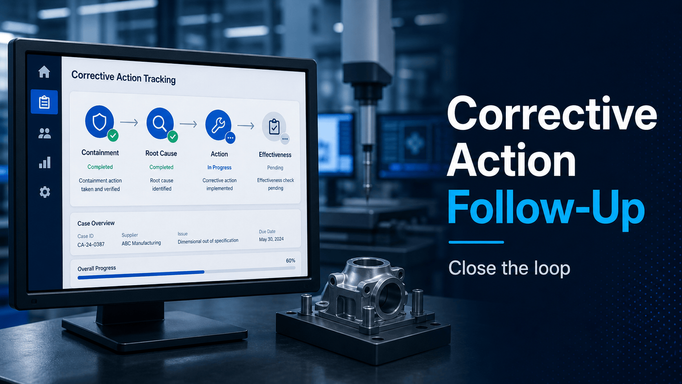
Supplier corrective action often starts with urgency.
A defect reaches incoming inspection. A line stops. A customer complaint points back to a supplier. A containment action is needed. The supplier is asked for an 8D, SCAR response, NCR response, or corrective action plan.
At first, everyone pays attention.
Then the process slows down.
The supplier submits a partial response. Root cause is unclear. Evidence is missing. Due dates slip. Someone follows up by email. The issue is discussed in a meeting. A spreadsheet status gets updated manually. Eventually, the corrective action is marked closed, but no one is fully confident the problem will not repeat.
That is where supplier corrective action processes often fail.
The hard part is not opening the issue.
The hard part is closing the loop.
Start with one clear issue record
Corrective action follow-up needs a single source of truth.
The issue record should capture the basic facts:
- supplier
- affected part or material
- plant or location
- issue description
- defect type
- severity
- date found
- containment status
- internal owner
- supplier owner
- due dates
- required response type
If the issue record is incomplete, the follow-up will be weak.
Suppliers need enough detail to respond properly. Internal teams need enough context to review the response. Management needs enough structure to understand status, risk, and trends.
The issue record should also connect to evidence such as photos, inspection results, defect samples, non-conformance reports, customer complaints, or chargeback information when relevant.
Separate containment from root cause
Containment is not corrective action.
It is the immediate work to protect production and customers while the real problem is investigated.
A good workflow should separate:
- immediate containment
- suspect material identification
- sorting or rework
- shipment holds
- replacement shipments
- short-term process controls
- root cause investigation
- permanent corrective action
This distinction matters because teams sometimes close too early. A supplier may contain the problem quickly, but the root cause remains unresolved. If the workflow treats containment as closure, repeat issues become more likely.
Containment should have its own status and due date. Root cause and permanent corrective action should have theirs.
Require structured supplier responses
Supplier responses vary widely when the process is managed through email.
Some suppliers send a completed 8D. Some send a short explanation. Some send a PowerPoint. Some answer only the containment question. Some skip evidence. Some provide a root cause that is really just a symptom.
A structured workflow helps standardize the response.
Depending on the issue, the supplier may need to provide:
- containment action
- root cause analysis
- 5-Why
- Fishbone or Ishikawa analysis
- corrective action plan
- responsible owner
- implementation date
- verification evidence
- preventive action
- recurrence controls
- updated control plan or work instruction
The goal is not paperwork for its own sake.
The goal is to make sure the supplier response is complete enough to review.
Track due dates and escalations
Supplier corrective actions often stall because due dates are not actively managed.
An 8D may have several deadlines: containment, root cause, corrective action plan, implementation, and effectiveness verification. If all of that is tracked in one spreadsheet cell, the team loses visibility.
A better process tracks due dates by step.
For example:
- containment response due in 24 hours
- root cause due in 5 business days
- corrective action plan due in 10 business days
- implementation evidence due by agreed date
- effectiveness check due after production validation
When a due date is missed, the workflow should make that visible. Critical issues may need escalation to the buyer, supplier quality manager, plant quality leader, supplier development, or supplier leadership.
Manual follow-up should not be the control mechanism.
Verify effectiveness before closure
Corrective action closure should not mean "supplier sent a response."
It should mean the action was reviewed and found effective.
Effectiveness checks can include:
- inspection results after implementation
- production run evidence
- updated process documentation
- audit evidence
- reduced defect recurrence
- supplier confirmation with supporting records
- internal SQE approval
For repeat or high-severity issues, closure may require stronger evidence and a longer validation period.
This is where many processes are too weak. If effectiveness checks are informal, issues get closed based on hope instead of evidence.
Use corrective action history to prevent repeat problems
Corrective action data should improve supplier management.
If a supplier has repeated defects, slow responses, weak root cause analysis, or overdue corrective actions, that should be visible in supplier reviews, scorecards, audits, and development plans.
Useful metrics include:
- open corrective actions by supplier
- overdue actions
- average response time
- repeat issue rate
- containment response time
- effectiveness failures
- cost of poor quality
- issue severity trends
When corrective action data is disconnected, teams miss patterns.
When it is connected to the supplier record, it becomes a management tool.
Where Supplios can help
Supplios helps manufacturers manage supplier corrective action follow-up through structured supplier quality workflows.
The Supplier Quality and Supplier Claims capabilities can support 8D, SCAR, NCR, CAPA, containment, root cause analysis, supplier tasks, due dates, evidence collection, approvals, reports, and follow-up verification. Supplios can also help keep supplier communication, attachments, status, and history connected to the issue record.
That makes corrective action easier to manage across suppliers, plants, and internal teams.
Corrective action is not done when the supplier replies.
It is done when the issue has been contained, the cause is understood, the corrective action is implemented, the evidence has been reviewed, and the risk of recurrence has been reduced. A structured workflow gives supplier quality teams a better way to make that happen.