Why Supplier Scorecards Don't Improve Performance by Themselves
Supplier scorecards only improve performance when they are connected to ownership, follow-up actions, supplier accountability, and a real supplier performance process.

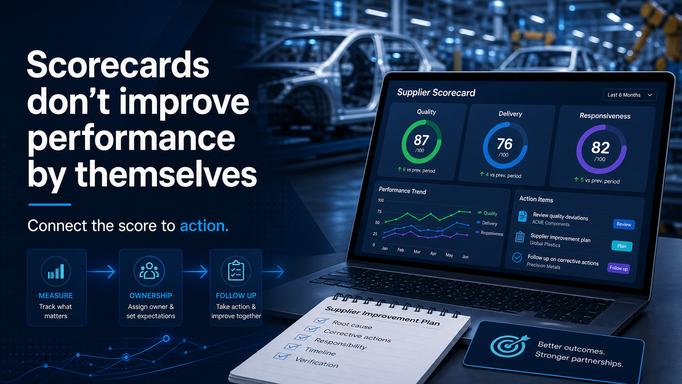
Supplier scorecards are a strange thing.
Almost every serious automotive manufacturer has them.
Far fewer can point to a supplier and say, "This scorecard is the reason performance improved."
That is not because scorecards are useless. They are not. Supplier scorecards can be one of the most useful tools for managing quality, delivery, responsiveness, and supplier development.
But a scorecard does not improve anything by itself.
It can show that a Tier-1 or Tier-2 supplier is missing delivery targets. It can show recurring PPM issues. It can show slow 8D responses, late PPAP submissions, weak responsiveness, or repeated documentation problems.
But showing the problem is not the same as fixing it.
That is where many supplier scorecard processes break down.
The scorecard exists. The numbers are reviewed. The same suppliers show up as problems again next month or next quarter.
Nothing really changes.
The issue is not the scorecard. The issue is that the scorecard is not connected to the work that comes after it.
A scorecard is a signal, not a solution
A supplier scorecard should tell your team where attention is needed.
That is its first job.
It can help identify suppliers with delivery instability, quality problems, slow response times, weak documentation discipline, or repeated corrective action delays.
In automotive, that visibility matters. A supplier issue is rarely isolated. A late component can affect production. A quality spill can create containment work. A weak 8D can leave the same problem open for months. A missing certification or PPAP document can slow down a program.
The scorecard can make those patterns visible.
But visibility is only the start.
If a supplier receives a low score and nothing happens, the scorecard is just a report. If the score gets reviewed internally but no one owns the follow-up, it is still just a report. If the supplier gets a PDF but no clear next step, it is still just a report.
A scorecard becomes useful when it triggers a decision or action.
That might mean a supplier review.
It might mean an improvement plan.
It might mean a corrective action.
It might mean an audit.
It might mean a temporary escalation, quality hold, or new business hold.
The exact action depends on the process.
But there needs to be a process.
Measurement does not create accountability
This is the trap.
Teams assume that because something is measured, someone is managing it.
That is often not true.
A supplier can have a weak delivery score for three straight months, and still no one owns the recovery plan.
A supplier can have recurring quality issues, and the scorecard can show it clearly, while the actual corrective action follow-up sits in email between an SQE and a supplier contact.
A supplier can miss PPAP or APQP-related deliverables, and the scorecard can reflect the problem, while the program team, purchasing team, and quality team each assume someone else is handling the escalation.
That is not supplier performance management.
That is supplier performance reporting.
Accountability requires more than a number.
It requires an owner.
It requires a due date.
It requires a defined expectation for the supplier.
It requires a way to track whether the supplier responded, whether the response was accepted, and whether the issue actually improved.
Without that, the scorecard may create awareness, but it does not create accountability.
The missing link is follow-up
The most important question in any scorecard process is simple:
What happens next?
If a supplier drops below target, what happens?
If a supplier misses delivery targets for two months, what happens?
If a supplier has repeated 8D delays, what happens?
If a supplier is trending worse across multiple plants, what happens?
If the answer is unclear, the scorecard process is incomplete.
Many automotive teams have strong scorecard templates. They know which KPIs matter. They track PPM, OTD, responsiveness, premium freight, rejected lots, delivery misses, open corrective actions, audit findings, and other metrics.
The weak point is not always the measurement.
The weak point is the handoff from measurement to action.
The scorecard says the supplier is underperforming.
Then the work moves somewhere else.
One person sends an email. Someone else updates a spreadsheet. A buyer mentions it in a supplier call. An SQE opens a corrective action. A plant manager asks for an update in a meeting. The supplier says they are working on it.
Three weeks later, no one has a clean view of what is open, what is overdue, what was agreed, and what changed.
That is how scorecards lose power.
They identify issues, but they do not control the follow-up.
Suppliers need more than a score
Suppliers also need clarity.
A supplier receiving a scorecard should understand four things:
- What changed?
- Why does it matter?
- What action is expected?
- When does the customer expect a response?
That sounds obvious, but many scorecard processes do not work this way.
The supplier gets a scorecard as an attachment. Or a dashboard screenshot. Or a spreadsheet. Or a quarterly business review deck.
The numbers are there.
The expectation is not.
This is especially important in automotive, where supplier performance discussions can involve purchasing, supplier quality, logistics, engineering, program management, and plant operations.
If the supplier is underperforming on delivery, is the expected response a recovery plan?
If the supplier is underperforming on quality, is the expected response an 8D?
If the supplier is late on PPAP submissions, is the expected response a task list with dates?
If the supplier is trending down across several plants, is the expected response a management review?
The scorecard should not leave that open to interpretation.
It should make the next step clear.
A low score should trigger a defined path
Not every low score needs the same response.
That matters.
If the process is too heavy, teams will avoid using it. If every minor issue creates a formal escalation, the system becomes noise. If every poor score requires a long meeting, the process will collapse under its own weight.
But there should be defined paths.
For example:
- A small score drop might trigger a supplier acknowledgement.
- A repeated miss might trigger a review meeting.
- A quality trend might trigger a corrective action.
- A delivery trend might trigger a recovery plan.
- A severe or repeated issue might trigger a supplier development plan.
- A high-risk supplier might trigger an audit or escalation.
- A supplier that fails to respond might trigger a status change or new business hold.
The point is not to punish suppliers.
The point is to make the process predictable.
Suppliers should know what happens when performance drops. Internal teams should know who owns the next step. Leadership should be able to see whether action is happening.
That is when scorecards start to matter.
Automotive scorecards need cross-functional ownership
Automotive supplier performance is not owned by one function.
Purchasing may own the commercial relationship.
Supplier quality may own defects, 8D, SCARs, audits, and corrective actions.
Operations may feel the delivery impact first.
Engineering may be involved when the issue affects PPAP, APQP, drawings, specifications, or change management.
Program teams may care most when supplier performance threatens a launch.
That cross-functional reality is one reason supplier scorecards often stall.
The scorecard shows the problem, but the ownership is split.
A delivery problem may need purchasing and logistics.
A quality problem may need SQE and plant quality.
A launch readiness problem may need engineering, program management, and supplier quality.
If the scorecard process does not assign ownership clearly, everyone can see the issue and still no one moves it forward.
That is why scorecards should be tied to workflows, not just metrics.
The score is the signal.
The workflow is how the organization responds.
Spreadsheets make the gap worse
Spreadsheets are often where supplier scorecards begin.
That is understandable. They are flexible, familiar, and easy to start with.
But they are weak at follow-up.
A spreadsheet can calculate a score. It can show trends. It can even create a decent-looking report.
What it does not do well is manage the work after the score is created.
It does not automatically assign the buyer, SQE, supplier development engineer, or supplier contact to the next action.
It does not reliably track supplier acknowledgements.
It does not connect the score to an 8D, audit finding, improvement plan, or supplier status change.
It does not give leadership a clean view of which low-scoring suppliers have open actions and which ones are being ignored.
So the scorecard gets built in a spreadsheet, and the actual supplier management process spreads across email, meetings, shared folders, ERP notes, QMS records, and individual memory.
That is where the process breaks.
The scorecard may be accurate.
But the system around it is not strong enough to drive improvement.
The real goal is a supplier performance system
The goal is not to have a scorecard.
The goal is to have a supplier performance system.
That system should help your team:
- gather supplier performance data
- calculate scores consistently
- share results with internal teams and suppliers
- identify trends and weak spots
- trigger follow-up actions
- assign owners and due dates
- track supplier responses
- connect scorecard results to audits, claims, improvement plans, and supplier reviews
- show whether performance is actually improving
That is a much higher bar than creating a monthly or quarterly scorecard.
It is also where the value is.
In automotive, supplier performance problems are too important to stay trapped in static reports. If a supplier is trending down, the team needs to know. If an action plan is overdue, the team needs to know. If the same issue repeats after corrective action, the team needs to know.
The scorecard should be part of that operating system.
Not a standalone artifact.
How Supplios helps connect scorecards to action
Supplios helps manufacturers move supplier scorecards from static reports into a connected supplier performance process.
With supplier performance in Supplios, manufacturers can build customizable supplier scorecards, automate KPI reporting, deliver results to internal teams and suppliers, and connect scorecard outcomes to follow-up actions and improvement plans.
That matters because the hard part is not only calculating the score.
The hard part is making sure the score leads to the right work.
Supplios also connects supplier performance to broader supplier management workflows, so scorecards can sit alongside supplier data, tasks, documents, communication, claims, audits, onboarding, and other supplier lifecycle activity.
For automotive manufacturing, that connection is especially important. Supplier scorecards are tied to quality performance, delivery performance, supplier development, PPAP/APQP readiness, 8D and SCAR follow-up, compliance, and cross-functional supplier accountability.
If your supplier scorecards are showing problems but not changing outcomes, the fix is probably not another spreadsheet tab.
The fix is to connect scorecards to the supplier work that comes next.
That is what turns supplier performance reporting into supplier performance management.