Why RFQ Automation and Supplier Quality Belong in the Same Platform
Manufacturers make better supplier decisions when RFQs, supplier quality, risk, compliance, onboarding, and supplier nomination workflows share the same operating system.

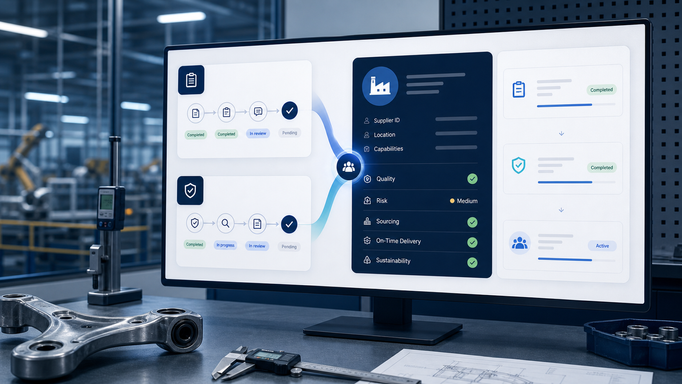
Most manufacturers do not think about sourcing and supplier quality as completely separate disciplines.
They know the work is connected.
A buyer wants to send an RFQ, but the supplier has an unresolved quality issue. A sourcing team is preparing a supplier nomination, but the supplier's certificates are expired. A supplier looks commercially attractive, but the last audit raised concerns. A new program needs to move fast, but onboarding, PPAP, risk review, and supplier quality follow-up are all happening in separate systems.
The process may be cross-functional, but the tools often are not.
That gap creates slow handoffs, missed risk signals, duplicate supplier requests, and too much manual checking before teams can make confident supplier decisions.
RFQ automation and supplier quality management are stronger when they live in the same supplier operations platform. Not because every workflow should look the same, but because supplier decisions depend on information from many functions.
Supplier rules should be enforced automatically
Most manufacturers already have rules built into their supplier-related processes.
Some are formal rules. Some are working habits. Some are quality requirements that everyone understands but still has to remember manually.
For example:
- do not send an RFQ to a supplier that is not approved for the required commodity
- do not nominate a supplier with blocked status or missing compliance documentation
- involve supplier quality before awarding a high-risk or production-critical part
- require additional review when a supplier has poor scorecard performance
- confirm certifications, plant contacts, risk status, and audit results before key sourcing decisions
When sourcing and supplier quality are managed in separate tools, these checks often depend on people remembering where to look.
The buyer checks one system. Supplier quality checks another. Compliance may have its own spreadsheet or portal. Risk information may sit somewhere else. If the deadline is tight, the team may move forward first and clean up the process later.
That is where problems start.
An integrated platform can make these rules part of the workflow. It can surface supplier quality, compliance, risk, onboarding, and performance information during the RFQ and supplier nomination process, not after the fact.
The result is not just better control. It is less administrative work.
Quality and risk problems should show up before supplier nomination
Waiting until the formal supplier nomination process to discover a quality or risk problem is too late.
At that point, the commercial analysis may already be complete. The preferred supplier may already be clear. Internal stakeholders may already be aligned. The program timeline may already assume that supplier will be selected.
Then supplier quality raises a concern.
Maybe the supplier has an open corrective action. Maybe their latest audit result requires follow-up. Maybe a required certification is missing. Maybe their recent delivery or quality scorecard trend is poor. Maybe the supplier is approved at the company level but not at the specific site that would produce the part.
Those are not details. They are decision inputs.
The earlier these signals appear in sourcing, the more useful they are. A buyer can include another supplier in the RFQ. Supplier quality can start a review earlier. The team can ask targeted questions before the award decision is locked in. Management can understand the tradeoff between cost, timing, capacity, and quality risk.
Integrated sourcing and supplier quality workflows help teams make supplier decisions while there is still time to change course.
Development cycles move faster when follow-on work starts automatically
Manufacturing sourcing work does not end when the RFQ closes.
The supplier nomination process often triggers a long chain of follow-on work:
- supplier onboarding
- supplier risk review
- quality audits
- PPAP or APQP activity
- documentation collection
- compliance checks
- internal approvals
- supplier setup or ERP updates
- launch readiness follow-up
When each activity is managed in a separate tool, every handoff becomes a chance for delay.
Someone has to notify supplier quality. Someone has to start the onboarding checklist. Someone has to send the supplier a separate request. Someone has to tell the program team whether PPAP has started. Someone has to update a spreadsheet so management can see what is open.
None of that work is strategically valuable, but it still consumes time.
In an integrated platform, the right supplier activities can start from sourcing milestones. A high-risk RFQ can trigger supplier quality review. A supplier nomination can launch onboarding or compliance tasks. A production award can start PPAP or APQP follow-up. A new supplier can receive the right data requests without the buyer rebuilding an email package from scratch.
This does not remove the need for judgment.
It removes the avoidable waiting time between decisions and execution.
RFQ tools need to support more than formal RFQs
When manufacturers evaluate RFQ automation, they often focus on traditional price quote workflows.
That makes sense. Direct material RFQs are complex. Teams need to manage drawings, specifications, cost breakdowns, tooling, packaging, logistics, lead times, supplier responses, and quote comparisons.
But many supplier data-gathering needs are not formal RFQs.
Teams also need to ask suppliers questions such as:
- Can you support this process or capability?
- Which plant would produce this part?
- Do you have capacity for this volume?
- Can you meet this customer-specific requirement?
- What certifications apply to this site?
- Are you exposed to this material, region, or regulatory risk?
- What is your status on a launch readiness item?
- Can you provide ESG, compliance, or sub-tier supplier information?
These requests often sit in the blurry area between sourcing, supplier quality, compliance, supply chain, and engineering.
They are frequently urgent. They are often handled by email. They may not fit neatly into a traditional RFQ template, but they still matter to supplier decisions.
This is where a sourcing module becomes more valuable when it is part of a broader supplier operations platform. The same supplier-facing experience can support RFQs, RFIs, capability surveys, risk questionnaires, readiness checks, and targeted data requests.
Suppliers do not need to learn a new channel for every request. Internal teams do not need to keep rebuilding one-off trackers.
Adoption improves when people do not have to learn another supplier system
Software adoption is not just a training problem.
It is a workflow problem.
Buyers may own RFQs, sourcing events, supplier nomination, and commercial follow-up. Supplier quality may own audits, corrective actions, PPAP, certificates, and supplier performance. But in practice, each team still participates in the other's work.
A buyer needs visibility into quality status before making a supplier recommendation. An SQE may need to review sourcing context before approving a supplier for a new part. Compliance may need to understand which suppliers are being considered for production work. Program teams may need to know which supplier actions are open before launch.
If every function uses a different system, adoption has to be earned again and again.
One tool for sourcing. Another for quality. Another for compliance. Another for supplier data. Another for scorecards. Another for internal task tracking.
That is hard for internal teams.
It is even harder for suppliers.
Suppliers already deal with many customer portals. If one customer uses separate systems for RFQs, quality issues, onboarding documents, compliance surveys, and scorecards, supplier engagement suffers. People fall back to email because it is the only place where all the requests seem to meet.
An integrated supplier platform creates a more practical adoption path. Once users understand one supplier workspace, adding another workflow is much easier. Buyers, SQEs, compliance teams, and suppliers build familiarity with the same records, tasks, notifications, and collaboration model.
That creates a compounding effect. More workflows in the same platform make the platform more useful, which makes adoption easier, which improves supplier engagement.
Supplier master data is bigger than ERP data
Many teams think of supplier master data as the information that lives in ERP.
Address. Tax ID. Bank details. Payment terms. DUNS number. Vendor number.
That data matters, but it is only part of the supplier picture.
The supplier data that teams need for daily operations is much broader:
- supplier contacts by function, plant, region, and escalation path
- approved production sites
- commodity and capability information
- RFQ history and responsiveness
- price competitiveness over time
- certification status
- audit history
- open corrective actions
- PPAP and launch readiness status
- compliance documentation
- risk scores
- scorecard performance
- supplier development actions
This data is cross-functional. It changes constantly. It usually does not live cleanly in ERP.
It also becomes more valuable when connected.
RFQ responsiveness is more useful when viewed alongside quality performance. Certification status is more useful when visible during sourcing. Audit history is more useful when tied to supplier nomination. Contact data is more useful when buyers, SQEs, and suppliers are all working from the same record.
That is the real supplier master data manufacturers rely on to operate.
An integrated supplier operations platform does not replace ERP. It complements ERP by managing the supplier-facing operational data that ERP was not designed to handle.
Separate systems are expensive even when they are modern
It is easy to underestimate the cost of separate systems.
Modern cloud software can still be hard to connect in a way that supports real operational workflows.
If RFQs live in one tool and supplier quality lives in another, teams eventually need integration points:
- supplier records
- supplier approval status
- supplier risk and compliance data
- award or nomination decisions
- part, project, or program context
- PPAP, audit, onboarding, or corrective action triggers
- reporting and management dashboards
These integrations require decisions about ownership, data mapping, timing, permissions, exceptions, and support. They also usually require internal IT time.
Even when the integration is technically possible, it may not happen quickly. And if it does happen, the business still needs to maintain it as processes change.
Putting more supplier-facing work in one platform does not eliminate every integration need. Manufacturers still need ERP, PLM, QMS, and other core systems.
But it does reduce the number of unnecessary connections between supplier collaboration tools. It also moves more of the workflow connection work to the platform provider instead of the manufacturer's internal IT team.
That is a practical advantage, especially for teams that want to improve supplier operations without turning every process change into an integration project.
Management gets a clearer view of supplier decisions
Sourcing and supplier quality leaders often need to answer questions that cross system boundaries:
- Which suppliers are being considered for upcoming programs?
- Which nominated suppliers still have quality or compliance blockers?
- Which RFQs involve high-risk suppliers?
- Which suppliers are slow to respond across sourcing and quality requests?
- Which new suppliers still need onboarding, audits, PPAP, or approval steps?
- Which supplier risks could affect launch timing?
When data is scattered, management reporting becomes a manual exercise.
People pull exports. They reconcile supplier names. They ask teams for updates. They review spreadsheets that are already aging by the time the meeting starts.
An integrated supplier platform gives teams a better operating view. Sourcing status, supplier quality actions, supplier data, compliance status, scorecards, and open tasks can be connected to the same supplier record and program context.
That makes it easier to manage supplier decisions as a portfolio, not just as isolated transactions.
The point is not one giant workflow
The goal is not to force sourcing, supplier quality, compliance, and onboarding into one generic process.
These teams do different work. They need different workflows, permissions, forms, reviews, and reports.
The point is that those workflows should share the supplier context they all depend on.
RFQ automation is better when buyers can see supplier quality and risk information before decisions are made.
Supplier quality is better when SQEs can see sourcing and nomination context before follow-up starts.
Supplier data is better when suppliers maintain it in the same environment where they already respond to requests.
Supplier engagement is better when the supplier has one practical place to work with the customer.
That is why RFQ automation and supplier quality belong in the same platform.
Supplios is built around this idea. Manufacturers can use Supplios for Sourcing and Procurement, Supplier Quality, supplier management, PPAP/APQP, onboarding, compliance, scorecards, and supplier-facing workflows in one connected supplier operations platform.
If your sourcing and supplier quality processes are still split across disconnected tools, it is worth looking at what changes when supplier decisions, supplier risk, and supplier execution finally share the same system. See Supplios in action.