What Is a Supplier Quality Management System (SQMS)?
Learn what a supplier quality management system (SQMS) is, how it fits with your QMS, and what to look for in supplier quality software.

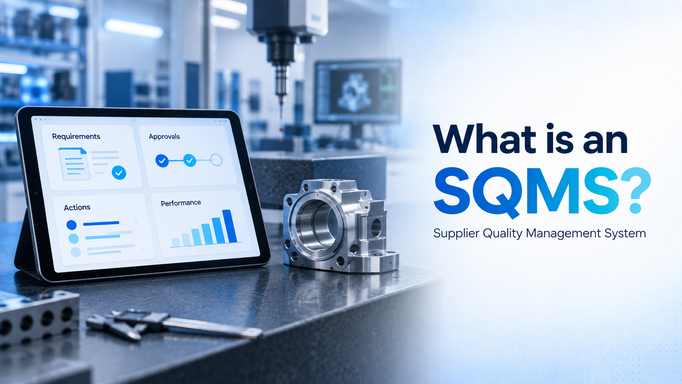
A supplier passes an audit. Their PPAP is still waiting for approval. A corrective action from another plant is overdue. Purchasing wants to know whether the supplier is ready for a new program.
Each answer exists somewhere, but getting a reliable picture means checking several systems and asking several people.
This is the problem a supplier quality management system (SQMS) should help solve: making supplier quality a consistent, connected process that manufacturers and suppliers can follow together.
What is a supplier quality management system?
A supplier quality management system (SQMS) is the combination of processes, responsibilities, information, and software a manufacturer uses to define supplier quality requirements, verify that suppliers meet them, resolve quality issues, and drive ongoing improvement.
It covers the work of qualifying suppliers, approving parts, maintaining quality documentation, managing audits and corrective actions, and monitoring supplier performance.
There are two useful ways to understand the term. The management system establishes how supplier quality is managed: who owns decisions, what evidence is required, and how problems are handled. SQMS software helps people carry out that work, share information, and keep records.
Supplier quality management, often shortened to SQM, is the discipline. An SQMS gives that discipline a repeatable structure.
Because SQMS is a less familiar label than QMS, it helps to be explicit about scope. Here, we use it to describe a manufacturer's system for managing quality across its supply base. Each supplier will also have its own quality management system.
SQMS vs. QMS: what is the difference?
Manufacturers often associate their QMS with internal activities such as controlled procedures, employee training, production quality, and internal audits. But a QMS has a broader scope. ISO describes a quality management system in terms of the policies, processes, and responsibilities an organization uses to manage and improve quality.
Supplier quality belongs within that overall quality framework. An SQMS provides a focused way to run the supplier-facing work.
| Area | Overall QMS | Supplier quality focus within an SQMS |
|---|---|---|
| Scope | Quality across the organization's activities | Quality of purchased parts, materials, and outsourced processes |
| Participants | Quality, operations, engineering, and other relevant teams | Supplier quality, purchasing, plant teams, and supplier contacts |
| Typical work | Document control, training, audits, nonconformances, and improvement | Supplier qualification, part approvals, supplier audits, corrective actions, and scorecards |
| Working relationship | Coordinates quality responsibilities throughout the organization | Coordinates tasks and evidence across company boundaries |
These scopes overlap. A QMS software product may already include supplier quality capabilities. Another manufacturer may use dedicated supplier quality software alongside its existing QMS and ERP.
The useful question is whether the tools support the process: can your team and your suppliers manage requirements, actions, approvals, and follow-up without rebuilding the workflow in email?
What should an SQMS cover?
The exact scope depends on your products, supplier risks, and customer requirements. For a manufacturer buying production parts, six areas provide a practical starting point.
1. Supplier qualification and quality requirements
Before placing production work, teams need to establish whether a supplier is suitable for the required part or process. That can involve capability assessments, questionnaires, audits, and internal approvals.
The system should make approval status meaningful. Which supplier site was assessed? For what scope? Are there conditions or open actions? An approval that hides those details gives purchasing and quality teams an incomplete basis for decisions.
2. Supplier documentation and certifications
Quality agreements, certificates, supplier manuals, and supporting records need owners, review steps, and follow-up.
For documents with an expiration date, the process should include renewal. For updated requirements, it should establish which suppliers need to respond or acknowledge the change. Teams should be able to distinguish a received document from one that has been reviewed and accepted.
3. Part approval and launch readiness
Supplier approval alone does not establish that a particular part is ready for production.
Where applicable, an SQMS should support Production Part Approval Process (PPAP), Advanced Product Quality Planning (APQP), or another defined approval process. This includes requested evidence, supplier submissions, internal review, resubmissions, and approval status. Launch teams need to see what remains open and who must act before the part can move forward.
4. Nonconformances and corrective actions
When a supplier quality issue occurs, the process needs to connect the defect record with containment, investigation, corrective action, and verification.
Structured methods such as 8D or supplier corrective action requests can guide the response. The system should make ownership, deadlines, supporting evidence, and review decisions visible. Closure should depend on the required verification, with follow-up proportionate to the issue's severity and recurrence risk.
5. Supplier audits and finding closure
Audit management extends from planning and assessment through to resolving findings.
An SQMS should help teams assign actions from each finding, obtain supplier evidence, and verify completion. Audit history also needs to remain useful after the report is filed: an unresolved finding may affect a supplier review, development plan, or approval decision.
6. Performance monitoring and improvement
Supplier performance measures can include defective parts per million (PPM), repeat issues, containment response times, and overdue corrective actions. Delivery and other operational measures may also inform the wider supplier review.
A useful system connects results with follow-up. If performance deteriorates, who reviews it? When is an improvement plan needed? How will progress be checked? Scorecards become more valuable when those responsibilities are explicit.
What makes these activities a connected system?
A manufacturer can have a process for every activity above and still spend hours assembling supplier status before each review meeting.
The connections matter as much as the individual workflows.
Shared supplier context. Records should connect to the relevant supplier, site, part, plant, or program. An SQE reviewing a new issue needs to find earlier problems affecting the same scope.
Clear ownership and follow-up. Each task needs a responsible person, a due date, and a defined next step. Reminders and escalation rules should support the team's process, including when a supplier response needs further work.
Direct supplier participation. Suppliers need a practical way to receive requirements, submit evidence, answer questions, and see what remains outstanding. A portal is useful when it supports those actions and keeps communication attached to the relevant record.
Traceable decisions. Internal teams need to understand what was submitted, who reviewed it, and why it was accepted or returned. Permissions should give each participant access to the information needed for their role.
Connections to existing systems. Supplier, part, inspection, and receipt data may already live in ERP, QMS, or engineering systems. Define which system owns each record and how relevant information reaches the supplier workflow. Integration needs will differ between manufacturers.
These are practical criteria for evaluating supplier quality management software. They also explain why a collection of spreadsheets becomes difficult to maintain as suppliers, plants, and open actions increase.
An SQMS example in automotive manufacturing
Consider an illustrative Tier 1 manufacturer receiving machined components from a supplier serving two plants. Incoming inspection at one plant identifies a recurring dimensional defect.
The SQE records the issue against the supplier site and affected part, attaches inspection evidence, and assigns containment and 8D response tasks. The supplier documents suspect material and immediate actions, then submits its investigation and proposed corrective action.
The SQE reviews the response. A statement that the operator has been retrained is insufficient if the investigation has not established why the process produced the defect or why inspection missed it. The task stays open while the supplier provides further evidence.
After implementation, the team verifies effectiveness using the agreed inspection results and follow-up period. The other receiving plant can see the relevant issue history and assess its own exposure.
The issue also feeds into the supplier's performance review. Recurrence may justify a targeted audit or development plan. If the corrective action involves a process change, the responsible team assesses whether updated part approval is required.
The value comes from maintaining continuity between the original defect, the supplier's actions, the verification decision, and future supplier management.
How to evaluate SQMS software
Ask potential providers to demonstrate a real workflow using a representative supplier quality issue or part approval. Include the supplier's experience and the internal review steps.
Useful questions include:
- Can suppliers see their tasks and submit structured responses and evidence directly?
- Can the workflow reflect your approval rules, deadlines, and escalation process?
- Can reviewers return incomplete submissions while retaining the history?
- Can teams identify overdue actions across suppliers and plants?
- Can claims, audit findings, and performance trends lead to tracked follow-up?
- Can you connect the required data with your existing ERP, QMS, and engineering systems?
Include the people who will use the process daily. A system needs to work for an SQE reviewing evidence, a supplier responding to a request, and a manager checking unresolved risks.
Start with a defined process and clear ownership. Software is easier to evaluate when you know what successful completion should look like.
Using Supplios as your SQMS
Supplios supports this approach through connected supplier records, supplier collaboration, and configurable workflows for quality claims, corrective actions, audits, documentation, part approvals, and performance management.
Its supplier quality capabilities support structured supplier responses, evidence, review, and follow-up. PPAP and APQP workflows connect supplier submissions with internal approval and launch activities. Workflows and integrations can be configured around the manufacturer's processes and existing systems.
That makes Supplios a practical option for manufacturers looking for an SQMS, including teams that already have an internal QMS and need a better way to coordinate supplier-facing work.
To evaluate the fit, bring one supplier quality process to a Supplios demo and walk through it from the initial requirement to verified completion.